


Time Zone: ET | GMT
ARTICLES INTRADAY
MARKET THOUGHTS
ANALYTICS FORUM BLOGS MEDIA ZONE BOOK USEFUL LINKS  


Aussie's Risk-Based Bounce

February 3, 2009 by Ashraf Laidi
(29 comments)
Print Share/Bookmark

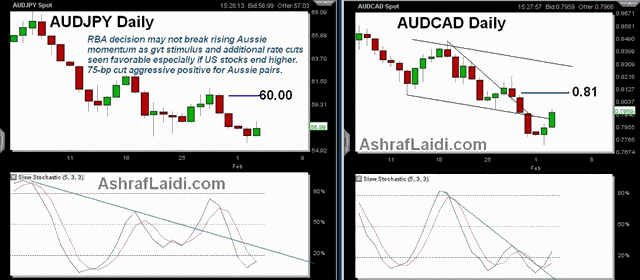
Aussie is the days best performing currency out of a group of 9 currencies due to market optimism resulting from the latest government stimulus package of A$42 billion and the latest aggressive rate cut from the RBA.

AUDJPY is seen particularly bullish in the event of a positive close in US equities and Asia, which would trigger fresh risk buying and an additional boost for the pair. Last week's 150-bp rate cut from the RBNZ to 3.50% took rates below those of Australia for the first time in 10 years. The RBA had to cut by 100-bps to keep its rates below the RBNZ's. Considering emerging Aussie optimism from monetary and fiscal stimuli, the 100-bp cut would be deemed neutral too positive, may helps boost the currency to as high as the 65-cent figure. AUDNZD is likely to extend gains towards 1.28.
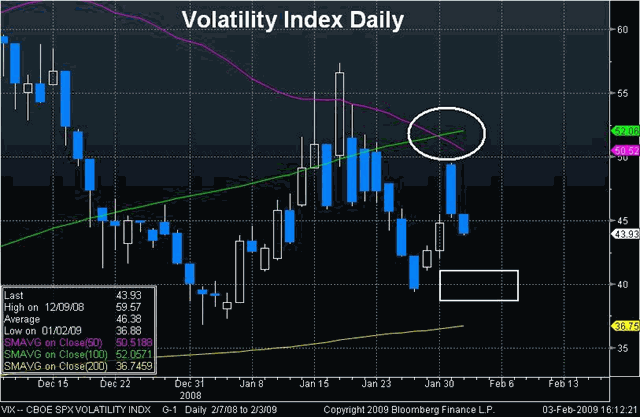
The VIX chart is set for further declines in the short-term, heading towards the 40 level (from todays 43.90), with market bulls likely to eye the 200-day moving average (currently at 36.75). Rather than the end of the bear market, the incoming retreat in volatility is seen as another temporary opportunity for the next relief rally in the VIX (and renewed pullback in stocks).
Risk appetite is also boosted by the Bank of Japans decision to buy risk assets via its purchase of shares in major Japanese banks. Seven years after the BoJ purchased shares in ailing banks to stabilize the tumbling equity market, the central bank returns overnight with a purchase of 1 trillion yen worth of shares aimed at boosting top banks capital. The purchases, which will go into effect until April 2010, is a reflection of the escalating risks emerging from falling bank lending, a soaring yen, and deteriorating capital partly dragged by struggling equities.

Cognizant of the incoming event risks from data releases that are likely to trigger fresh yen strength, the BoJs purchases may also be aimed at staving off the exceedingly positive bias in the currency. Recall that the BoJ purchases of Japanese shares in 2002 coincided with yen-selling intervention--which at the time had more fundamental validity as Japan was isolated in a deflationary spiral. Today, however, any overt intervention to sell the yen has little fundamental support due to the persistently downward path in G10 interest rates and negative risk environment.


 
    Comments By Users (29)   (View All Comments)    Post a comment

London, UK

February 12, 2009 04:31 ET
Amit, thanks for your insightful question. Yes, it is true that 10-yield differentials are directly proportional to the currency with the higher spread. But as you correctly put it, the main difference emerges when rising yileds result largely from increased borrowing. This week, the US Treasury will raise a record $67 billion in borrowing (some for new borrowing and some for refunding its existing debt obligations). The way I see it is the following: rising US-EU spread may support USD vs EUR (or prevnt it EUR from regaining $1.31 right away) but the LONG TERM fundamentals of the US economy are negative.

Ashraf
Connecticut, US

February 11, 2009 13:06 ET
As always, excellent analysis Ashraf.

There is something i wanted you to clarify if possible. Your comment in the last HOT-chart post "USD downside risks underlined by record Treasury borrowing, which is boosting yields at expense of USD. "

Know how short term forex traders consider the US-Euro 10yr yield spread, (which correlates inversely with EUR/USD pair), well, if the US yields rise faster than the Euro yields, US-Euro spread would be becoming more positive, therefore, a short EUR/USD action would present itself. Is the main difference in argument invalid due to a supply shock of Treasuries, where the private demand for Treasuries is insufficient or not attractive enough.

It just seems contradictory, so i presume there is something vital i am missing.
London, UK

February 11, 2009 08:23 ET
John, I cannot give all my outlook rates on here for each of these pairs but roughly speaking we can see eurusd $1.35-1.38, gbpusd $1.40-1.45, eurjpy 116-123.

I will talk about these forecasts in more detail and take other questions at the NY Traders expo in NY on Feb 21-23.

Ashraf
Utah, US

February 11, 2009 01:54 ET
Hello, Ashraf,
Do you have any advices on 1-3 month projection for EUR/USD, GBP/USD, EUR/JPY and GBP/JPY?
Regards.
London, UK

February 10, 2009 07:59 ET
str8fx, USDCHF seen pulling back towards 1.1515 in short term as CHf strength seen emerging against both USD and EUR. Also consider EURCHF as it may slides back towards 1.4950s.

Ashraf
Toronto, Canada

February 9, 2009 18:23 ET
any views on usd/chf?
tia.
Toronto, Canada

February 9, 2009 18:22 ET
any views on usd/chf?
tia.
London, UK

February 9, 2009 08:14 ET
Waqar, USDJPY is the least strong JPY pair. We may see improved risk appetite today (geithner, obama and bernank will speak this week) so theme may be holding the hands of the financial system while few data releaes are out. weak USDJPY bias to remain, but weak JPY vs AUD and GBP may continue into mid week.

Ashraf
Lahore, Pakistan

February 9, 2009 05:08 ET
Hi Ashraf

thanks for the insightful analysis.Caught you on Bloomberg this morning.What do you think of this divergence between the dollar and yen we are seeing today.Do you see this trend of weakening dollar and stronger yen as a temporary phenomenon or something more long term.

Regards

Waqar
London, UK

February 9, 2009 01:54 ET
Waqar, fundamentals don't warra nt such an extended gain in cable for now.

Steve, passing the stim package and resulting rise in appetite is the reason to rising cadchf. I think your stop will be hit on Monday. Either close at a loss or consider hedging by buying AUD vs CHF.

Francis, EURUSD at $1.3030 is the intermediate resistance. USDJPY still struggles to post gains. we may have broken above 92 but any renewed break above that is unlikely to exceed 94.60s. Downtrend remains intact. just be careful with stop placement.

Ashraf

    19 more comments...

You must be signed in to post comments.
 
   
Subscribe to Ashraf's Newsletter
Email:


Analytics

 
Hot-Chart - Dec 13
Where to for Gold & Silver?   Our Premium subscribers may not be surprised by the $100 decline in gold over . more..
 
Forex Charting
Forex Charts Powered by Forex Pros - The Forex Trading Portal.
 
 
Ashraf's Book:

Currency Trading and Intermarket Analysis
How to Profit from the Shifting Currents in Global Markets [read more..]
[buy now]
 
Tag Cloud (Top 20)

 
Interest Rates
US0.25%
 
JPN0.10%
 
EUR1.00%
 
GBP0.50%
 
CHF0.50%
 
AUD4.25%
 
CAD1.00%
 
NZD2.50%
 
NOK1.75%
 
 
Intraday Market Thoughts

2012.02.03: The strength of todays jobs report and services ISM attained the rare pattern of triggering a USD rally despite broad advances in US equities. The risk-on-risk-off rule of punishing the US currency during rallying equities does not apply when good

2012.02.03: UK PMI services strong; Eurozone retail sales declined; employment in Canada lower than expected and unemployment rate rose; estimates for 2/29 LTRO. Key event for NY is NFP followed by ISM non manufacturing. There are 5 already CAD shorts in the

2012.02.03: The yen and dollar are higher as risk trades are pared heading into US employment data and the weekend. The Australian dollar is lagging. Chinas services PMI fell in January in a tentative, but premature, sign of a cooling economy. Eurozone-wide and


Copyright 2008 © Ashraf Laidi.     Webmaster: | Privacy Policy
Loading...