



Dollar Slashed as Fed Goes Shopping
Today's serious case of dollar-damage was once again made courtesy of the nations central bank. The Feds purchase of $7.7 bln in 7 and 10-year treasuries in the morning, followed by purchases of $3.08 bln in Agency securities in the afternoon accelerated the dollar decline and the resulting rally in commodities --as was the case on March 18 when the Fed first announced purchases of long term treasuries. Today's dollar sell-off stood out from previous declines by the fact that EURUSD knifed through the key resistance of $1.3740 (failed 4 times this year) to $1.3830, and even sterling finally managed to break above its 200-day moving average vs USD--something that all majors currencies had achieved in previous weeks surging to a 7-month high of $1.5794.
Contrary to what some media concerns have stated, the dollar selling emerged well before the release of the FOMC minutes, which did accelerate the selling.
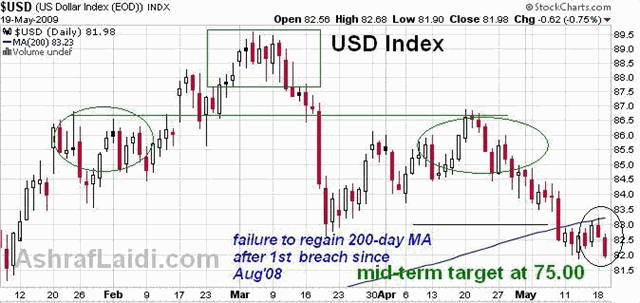
Improved risk appetite has never helped the dollar, but this time around, the yen (which is usually the broadest loser during rising equities) has in fact soared against vs. USD. Unless US Treasury Secretary Tim Geithner reiterates the strong dollar being in US interest (which could work temporarily), or equities come under severe pressure, the turnaround for the greenback is unlikely to emerge, to the benefit of commodities and equities. We long warned about the day of reckoning for the dollar emerging at the next economic recovery (a la 2004-5) where real demand for commodities combined with improved risk appetite seeks yield in emerging markets, commodity currencies, away from the fiscal deficiencies of the US economy and the excess reflationary build up accumulated by the Fed--all of which is accompanied by uninterrupted weakness in US labour and housing markets.
We reiterate the only viable driver for renewed USD strength would be fresh bout of selling in US and world equities prompting safe haven flows into cash (which remains denominated in USD treasuries), and/or news of failed banks in the Eurozone and/or the UK. Meanwhile, the case for metals (with a preference for silver over gold) remains evident as central banks rush to buy bonds that their very governments are rushing to issue.
VIX: From Fear to Greed?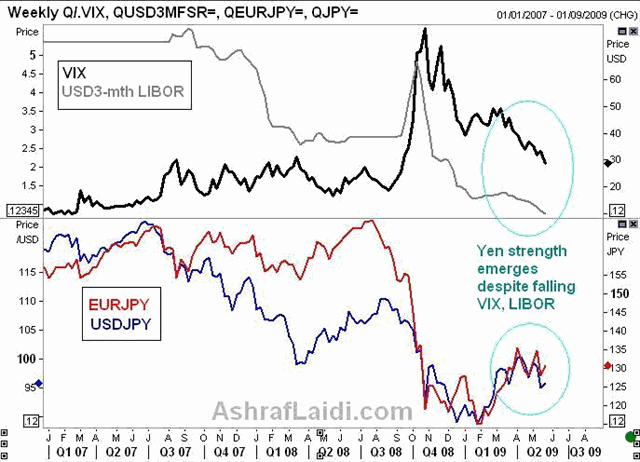
Much talk about the VIX breaking below 30 for the first time since the week of Lehman's downfall. Although the inverse relation between the VIX and equities is well documented, it is worth noting a few changes. The VIX rose to only 52 when stocks tumbled to 12-year lows in the first week of March, compared to a record high of 90 (some measures at 96) in late October, when stocks were at a 5-year lows. Said differently, the element of fear and volatility was less pronounced in early March when equities reached lower lows than it was in October-November. Thus, renewed selling can emerge without panic of a systemic breakdown, which can be a reflection of speculative shorts (March) rather than panic redemptions (October-November).
The above chart compares proxy measures of confidence/fear as expressed by interbank market, equities and currencies. The upper panel in the chart below shows the VIX (volatility in equities) versus USD 3-month LIBOR (confidence among banks), illustrating a fairly positive correlation. The sudden decline in LIBOR between Aug 07 and Mar 08 resulted from the Feds about turn from an inflation-centric monetary policy to aggressive interest rate cuts. While such a shift helped ease the interbank cost of short-term money in summer-fall 07, it failed to prevent the VIX from creeping higher.
The sharp decline in LIBOR since mid Q4 08 reflected the Feds zero interest policy, accelerating liquidity-injection measures and its purchase of mortgage-backed and agency securities. The recurring bounce in the VIX from its January low of 39 to the March high of 53 resulted from renewed selling in the S&P500 and the rest of global equity indices. Despite the fact that equities fell as far as 12-year lows, the VIX rebounded to half the level reached in October because the selling was more of a proactive strategies rather than reflexive trades. The subsequent tumble in the VIX below 30 is a combination of improved equity markets, reduced fears of a breakdown in the financial system and increased signs of a bottom in the economic data.
The risk view from Forex markets is shown in the lower panel of the above chart via USDJPY vs EURJPY, both measures of the yens continued tracking of risk appetite (falling yen pairs indicate stronger yen vs USD and EUR, which is in line with reduced appetite). But note how both EURJPY and USDJPY proved volatile over the past 2 months, with frequent bouts of yen strength occurring despite falling VIX, falling LIBOR and rising equities.
On the EUR and USD sides of the coin, weak EURJPY and USDJPY re-emerged partly due to conflicting ECB remarks about bonds purchases and broadening worries over the rising cost of US treasuries. The JPY side of the coin has not only reflected prolonged pre-occupation over the sustainability of the equity rally from the currency community, but also rumblings about Tokyos desire to further internationalize the value of the yen as well as requesting the US to issue Samurai bonds (yen-denominated bonds). Those claims were initiated by the leader of Japan's opposition Party, but happen to be shared by bureaucrats of the rulingestablishment. One valid argument opposing the view of ongoing risk aversion in Forex is that of sterling strength. The currency is now trading at its highest level this year on diss ipating signs of event risk from UK banks as well as prolonged signs of bottoming in property and equity markets (both key targets of vital capital flows).
EURUSD and GBPUSD may have broken on the upside, but GBPJPY, EURJPY, NZDJPY and CADJPY point to renewed selling (as early as Thursday's Asian session), suggesting prolonged erosion for USDJPY. This is in line with our long hed belief that sub-85 USD/JPY remains inevitable, and may not be seen until 2010. For more analysis on muti-year cyclical patterns in Forex & commodities, check out our Forex & Intermarket Dynamics Workbook