


Time Zone: ET | GMT
ARTICLES INTRADAY
MARKET THOUGHTS
ANALYTICS FORUM BLOGS MEDIA ZONE BOOK USEFUL LINKS  


EURIBOR, Euro & USD Index

August 3, 2010 by Ashraf Laidi
(15 comments)
Print Share/Bookmark

Many have expressed scepticism with strength of the euro at a time when EURIBOR and EUR-Libor rates remained on the rise. EUR 3-month LIBOR stands at 12-month high of 0.83%, up 46% from its March lows. Yet unlike in April-May when rising Eurozone rates resulted from plummeting inter-bank confidence and falling liquidity in the system, the recent strengthening in Eurzone interbank rates has been partly boosted by improved macroeconomic/bank earnings figures, as well as a stabilizing currency.

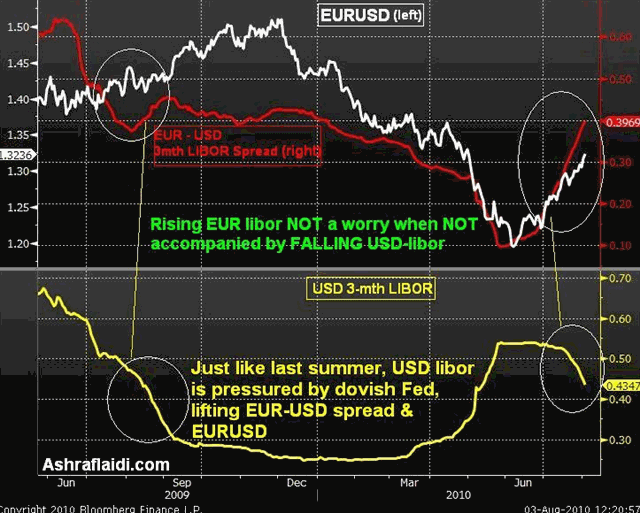
Rising EURIBOR and EUR 3-month LIBOR are primarily negative for the euro at times when eroding interbank confidence leads to a shortage of US dollars in the global monetary system, to the extent of boosting USD-denominated LIBOR. But thats not been the case over the past 6 weeks. While EUR 3-month libor has risen by more than 20-bps since the peak of the sovereign crisis in early June, USD 3-month LIBOR fell by nearly 15-bps during the same period. Weak US data, FOMC economic downgrades and broadening Fed dovishness have accelerated the decline in USD-libor. Consequently, the chart below shows the EUR-USD 3-month libor spread (EUR minus USD as indicated by red graph) to have risen to its highest level since January, closely followed by a rising euro.
Just Like in October 2009

The steepness of the EUR-USD libor spread is instrumental in boosting EURUSD, in a manner that is highly similar to Q3-Q4 2009 (left circle) when USD-libor fell below its Japanese counterpart for the first time. That was the time when markets allowed for the possibility of fresh QE in the US. As is the case today, the Federal Reserve was the only major central bank most likely to add on to its existing asset purchases, while the BoE had ended its QE program and the ECB standing pat. The result was a broad decline in the US dollar, coupled with rising equities and soaring energy and metal prices.

A 200-day MA unlike any other

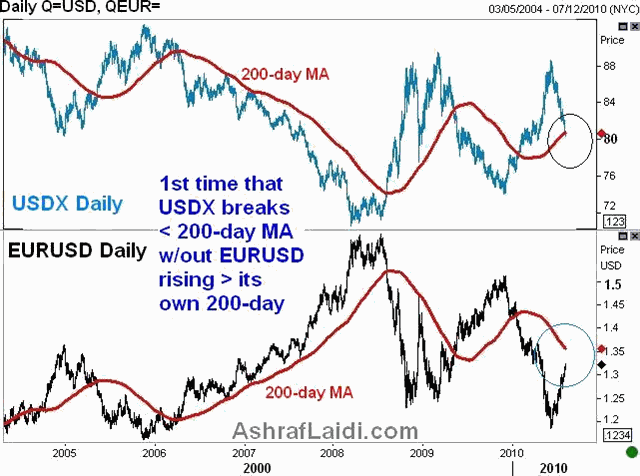
The US dollars decline made the headline today when the USD index hit 80.59, falling below its 200-day moving average for the first time since late January. The importance of such a decline will only be highlighted once the break of the 200-day MA lasts into mid-month. But theres something notable about todays development. It is the first time in the life of the euro that the USD index breaks below its 200-day MA, without EURUSD breaking above its own 200-day MA. The chart below shows EURUSD stands at $1.3230, which is about 3 cents below its 200-day MA. Considering that EUR occupies 57% of the 6-currency basket of the USD index, it can be deduced that the bulk of USDX losses have occurred against the other currencies in the index (JPY, GBP, CHF, CAD and SEK). Indeed, each of these currencies has risen above its 200-day MA against the USD dollar. With the euro lagging behind, this suggests the EURUSD rally is largely the result of USD weakness, which could be explained by lingering sovereign dent worries. But this may also serve a warning signal for the next leg of broad USD weakness once EURUSD breaks above its 200-day MA.
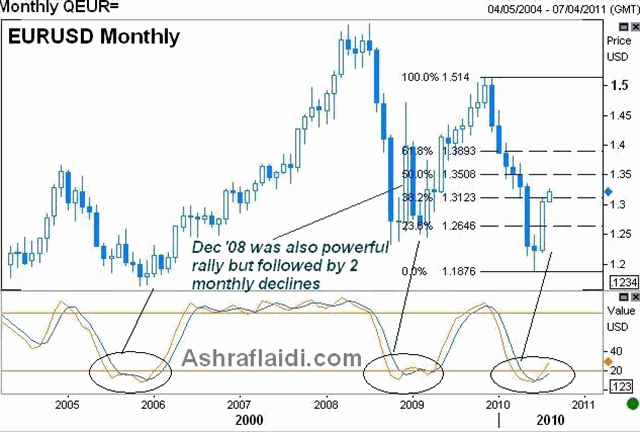
EURUSD has extended its rally across the board after closing above the important $1.3130s resistance. Despite a modest Tuesday pullback in US equities; risk currencies face little resistance in accumulating further ground against USD. EURUSD faces $1.3270 as the next technical target, which is the support from mid March to early April. Contrasting economic data between the US and Eurozone as well as the earnings performances on the banking sector continues to shore up the euro on the premise of broadening stabilization of inter-bank concernsand to a lesser extentrobust recovery in Germany. A little bit more help from Fed rhetoric will be crucial in extending EURUSD to the all-important 200-day MA (now at $1.3575)
.For more frequent FX & Commodity calls & analysis, follow me on Twitter Twitter.com/alaidi


 
    Comments By Users (15)   (View All Comments)    Post a comment

mulhouse, France

November 19, 2010 11:38 ET
Member since Aug 2009
we will have this target for next week on Tnotes
mulhouse, France

November 19, 2010 09:32 ET
Member since Aug 2009
us 10 years treasury cboe coming at 2.95/7
mulhouse, France

November 18, 2010 05:50 ET
Member since Aug 2009
US government 30 years heading to 4.30 4.32/33 by today tomorrow
mulhouse, France

November 8, 2010 05:17 ET
Member since Aug 2009
now it is all about a grenadier that boarded if i dont mistake in nicae.
jw
toronto, Canada

November 3, 2010 18:54 ET
Hello Ashraf,

I was just wondering on if you think the Russian Ruble is over/under valued against the USD right now. With the Ruble paying interest, where do you see the long term value of this exchange rate?

Jeff
jw
toronto, Canada

October 29, 2010 15:41 ET
Hello Ashraf,

I was just wondering on if you think the Russian Ruble is over/under valued against the USD right now. With the Ruble paying interest, where do you see the long term value of this exchange rate?

Jeff
Arizona, US

September 9, 2010 08:57 ET
Member since Aug 2009
China's UN diplomat in drunken rant against Americans:


http://www.telegraph.co.uk/news/worldnews/asia/china/7991414/Chinas-UN-diplomat-in-drunken-rant-against-Americans.html


b.
Alexandria, Egypt

August 9, 2010 19:33 ET
Excellent analysis Mr. Ashraf, Rate differentials is always been a reliable and valid tool for rate

analysis. I want to ask If the USD/JPY is an indicator of USd weakness against Euro? the Euro is

appreciating because the US dollar is weak. IF Eur Is rising because of high risk appetite and shifting of

cheap money to high yielders, then USD/JPY should appreciate (move in the same direction at least). is that analysis valid? since USD\JPY is downside pressured we assume a weak Dollar Fundamentally which do not mean a EURO relative strength (as in economic activity)

London, UK

August 4, 2010 16:58 ET
fx, carlco, agreed. lets be careful here. first we need to see USDX CLOSE the week BELOW its 200DAY MA then need EURUSD to follow thru above 1.34 and to 1.3570s.

Ashraf
India

August 4, 2010 13:36 ET
I think euro has turned 1.32 breakdown is around 1.315 odd 0.95 yea possible by next year .Lets see how it goes

    5 more comments...

You must be signed in to post comments.
 
   
Subscribe to Ashraf's Newsletter
Email:


Analytics

 
Hot-Chart - Dec 13
Where to for Gold & Silver?   Our Premium subscribers may not be surprised by the $100 decline in gold over . more..
 
Forex Charting
Forex Charts Powered by Forex Pros - The Forex Trading Portal.
 
 
Ashraf's Book:

Currency Trading and Intermarket Analysis
How to Profit from the Shifting Currents in Global Markets [read more..]
[buy now]
 
Tag Cloud (Top 20)

 
Interest Rates
US0.25%
 
JPN0.10%
 
EUR1.00%
 
GBP0.50%
 
CHF0.50%
 
AUD4.25%
 
CAD1.00%
 
NZD2.50%
 
NOK1.75%
 
 
Intraday Market Thoughts

2012.02.03: The strength of todays jobs report and services ISM attained the rare pattern of triggering a USD rally despite broad advances in US equities. The risk-on-risk-off rule of punishing the US currency during rallying equities does not apply when good

2012.02.03: UK PMI services strong; Eurozone retail sales declined; employment in Canada lower than expected and unemployment rate rose; estimates for 2/29 LTRO. Key event for NY is NFP followed by ISM non manufacturing. There are 5 already CAD shorts in the

2012.02.03: The yen and dollar are higher as risk trades are pared heading into US employment data and the weekend. The Australian dollar is lagging. Chinas services PMI fell in January in a tentative, but premature, sign of a cooling economy. Eurozone-wide and


Copyright 2008 © Ashraf Laidi.     Webmaster: | Privacy Policy
Loading...