


Time Zone: ET | GMT
ARTICLES INTRADAY
MARKET THOUGHTS
ANALYTICS FORUM BLOGS MEDIA ZONE BOOK USEFUL LINKS  


Green Shoots Fatigue & Intermarket Setup

June 29, 2009 by Ashraf Laidi
(71 comments)
Print Share/Bookmark

There are more substantive fundamental and technical grounds that the recent pullback in equities and global bond yields will extend throughout Q3 to the benefit of the US dollar, which will likely stabilize, rather than wage a rally such as in H2 2008. Current explanations for a stronger dollar in H2 based on US recovery preceding rest-of-world are off the mark. The past 7 years have proven that each time US data emerged on the stronger side, global bourses pushed higher-at the expense of the greenback. While we back the notion for a stronger USD in Q3, our rationale is based on the following:
(i) Necessary pullback in commodities after excessive gains (oil +43%, copper +30% aluminium +22% since late April) started hampering fragile stabilization in business activity;

(ii)
Retreat in global risk appetite due to lack of follow-through from econ data and business surveys;
(iii)
Reminders from non-US central banks to continue their quantitative easing;

(iv) Cautious currency rhetoric reining in excessive appreciation (SNB, ECB, BoE, BoC and RBNZ);

(v) Rising US and global unemployment rates cannot be dismissed as lagging indicators when their increase (from trough to peak) was among highest in record. In the US, combination of rising unemployment and savings rate do not function well in a debt-laden economy.

(vi) Emerging uncertainty with European stress tests could be deemed as an
event-risk excuse for deeper consolidation in the euro.

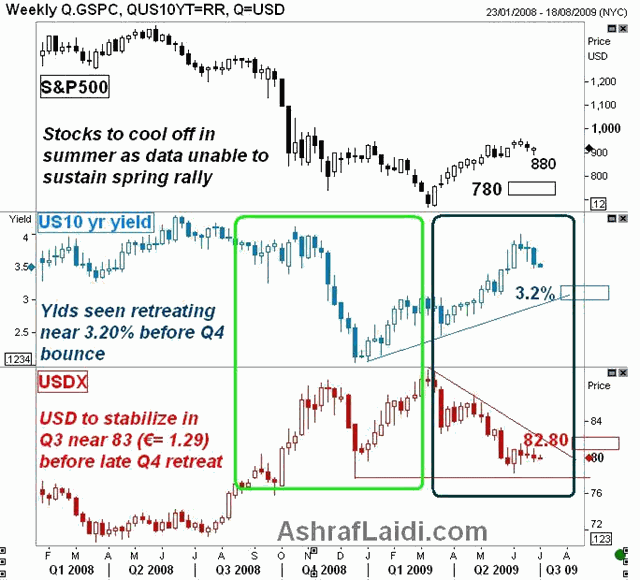
FX markets have grown increasingly used to watching key parameters of risk appetite, whose upside has become limited at 8,600 in the Dow, 930 in S&500 and 4,350 in the FTSE-100. Key support stand at 8,200, 880 and at 4,100 respectively.

Bond Yields & the Dollar

While bond yields have had their biggest weekly retreat in 3 months, the uptrend since late December is expected to remain intact as long as 3.20% and 2.25% yields hold on the 10 and 5-year treasuries respectively. As the charts above show, we could expect a continuation of the inverse relation between yields and the dollar.

To understand the future, we must understand the past and present relation. Note that between August 08 and March 09, yield and the dollar moved largely in tandem, only for the relationship to turn inverted thereafter as the Feds treasury purchases weighed on the dollar but failed to reverse the yield rally.

Hence, dollar downtrend intensified in March as the Fed's announcement to buy Treasuries implied monetization of the US debt via and increase in and out of the of US dollars. The other reason to the dollar decline was the protracted rally in emerging markets (especially the BRICS), which eroded global fund managers cash, which were largely-denominated in USD.

Meanwhile, bond yields continued to maintain their climb amid the US Treasury's record borrowing and deficit-financing overwhelmed the asset-purchasing efforts of the Fed, hence, caused a drag on treasuries and lifted their yields. Incipent signs of green shoots also boosted yields. In late Q4, we expect to yields resume their upward course as the Treasury's deficit financing combines with improved economic dynamics in and out of the US. And any environment portraying improved global dynamics has consistently proven to be challenging for the dollar.


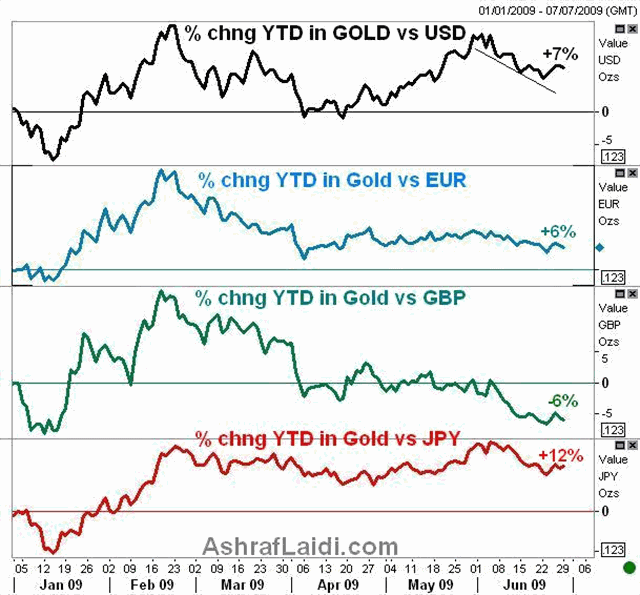
In response to our reader's requests, the following chart shows gold's year-to-date percentage change in USD, EUR, GBP and JPY terms. Reflecting the yen's broad underperformance, gold has shown the greatest advances against the yen; rising 12% YTD. In contrast, sterling's broad outperformance explains gold's 6% decline YTD against the curency. Improved risk appetite has largely benefited sterling especially as the govt owned UK banks left a void in the bad news medium, allowing sterling to maintain its strong correlation with equity market performance. Fore more historical analysis on gold's muti-currency performance, please review my year-by-year illustrations and rationale from 1999 to 2007 in Chapter 1 of my book Currency Trading & Intermarket Analysis

 
    Comments By Users (71)   (View All Comments)    Post a comment

July 4, 2009 07:30 ET
ashraf,

i'd say we will have a poor run in equities in short term with increased risk aversion due to poor economic numbers, containment of liqudiity expansion by fed (SHORT TERM) and bearishness/cautious attitude on recent risk rally among fund managers. shorting commodity based currencies and higher yielders will be profitable with CAD one of them. we are also likely to see dollar/yen carry trades unwound with flows back to these currencies in the short term.

also, based on our debate about us dollar debasement, it is my belief that the dollar will depreciate against BRICS on a great scale rather than G8/G10. therefore, the USDx will not suffer as many believe in the longer term. jim rogers is highly pro BRICS and not G10 for obvious reasons and i would agree.

as it will take many years for the world economies to recover and for the US to reduce their recently increased savings rate (for consumption trends pre2007), large gains for oil and downside on USDX will be limited.

have a good weekend
London, UK

July 3, 2009 20:49 ET
redstsone, we'd have to wait next week's down leg in equities. signal from oil looks quite ominous.

rob, not bad suggestions. And as i said in my tweet last night, EURAUD also looks to be stabilizing as stocks peak and fall. eurcad can be very volatile but that's not bad idea. but the way oil is going to fall more still presents shortterm opportunity for USDvsCAD

Ashraf
Rob
New York, US

July 3, 2009 15:18 ET
Member since Jan 2009
Hi Ashraf,

With USD strength being compromised by US debt and economy, BRIC moves out of USD, and China and Russia opening their mouths about different reserves - how do you feel about going long GBP/CAD (or EUR/CAD) instead of USD/CAD? Both pairs seem to have quite a strong upward channel in daily and weekly charts. Thanks
July 3, 2009 13:44 ET
Member since Jun 2009
Hi Ashraf. still holding JPY am waiting for stocks to head lower to cash in on risk aversion but would ultimately like to shift holdings to AUD. As to when, your advice would be greatly appreciated.
London, UK

July 2, 2009 20:03 ET
Rob, i overlooked your Qstn. but i guess cable is finally giving as NY was bad and Tokyo will mirror it

Ashraf
London, UK

July 2, 2009 20:01 ET
redstone, have your JPY holdings now turned to green? you said you were going to get rid of them in middle of Friday trading.

Ashraf
London, UK

July 2, 2009 17:36 ET
EUR$ eyes 1.3880 (target 1st mentioned this morning). NZDUSD looks to test 0.6240 then it's 0.6170 from there. USDCAD likes the way US session closed at session lows and testing 1.1630s & EUR hits 1.3950. THIS NITE IS SO NOT OVER. Over and out to twitter.

Ashraf
Rob
New York, US

July 2, 2009 15:36 ET
Member since Jan 2009
Guess it took another 25 points down in the dow to get it moving down
July 2, 2009 15:07 ET
could be large buy orders for the pound on a non-trading basis. can move markets if volumes thin
Rob
New York, US

July 2, 2009 15:04 ET
Member since Jan 2009
speculator - I agree, especially given the weak UK construction PMI - Also, China apparently has added another comment saying that the dollar as reserve was STABLE.

    61 more comments...

You must be signed in to post comments.
 
   
Subscribe to Ashraf's Newsletter
Email:


Analytics

 
Hot-Chart - Dec 13
Where to for Gold & Silver?   Our Premium subscribers may not be surprised by the $100 decline in gold over . more..
 
Forex Charting
Forex Charts Powered by Forex Pros - The Forex Trading Portal.
 
 
Ashraf's Book:

Currency Trading and Intermarket Analysis
How to Profit from the Shifting Currents in Global Markets [read more..]
[buy now]
 
Tag Cloud (Top 20)

 
Interest Rates
US0.25%
 
JPN0.10%
 
EUR1.00%
 
GBP0.50%
 
CHF0.50%
 
AUD4.25%
 
CAD1.00%
 
NZD2.50%
 
NOK1.75%
 
 
Intraday Market Thoughts

2012.02.03: The strength of todays jobs report and services ISM attained the rare pattern of triggering a USD rally despite broad advances in US equities. The risk-on-risk-off rule of punishing the US currency during rallying equities does not apply when good

2012.02.03: UK PMI services strong; Eurozone retail sales declined; employment in Canada lower than expected and unemployment rate rose; estimates for 2/29 LTRO. Key event for NY is NFP followed by ISM non manufacturing. There are 5 already CAD shorts in the

2012.02.03: The yen and dollar are higher as risk trades are pared heading into US employment data and the weekend. The Australian dollar is lagging. Chinas services PMI fell in January in a tentative, but premature, sign of a cooling economy. Eurozone-wide and


Copyright 2008 © Ashraf Laidi.     Webmaster: | Privacy Policy
Loading...