


Time Zone: ET | GMT
ARTICLES INTRADAY
MARKET THOUGHTS
ANALYTICS FORUM BLOGS MEDIA ZONE BOOK USEFUL LINKS  


Rising Yields Fight the Fed

April 27, 2009 by Ashraf Laidi
(42 comments)
Print Share/Bookmark

Cant' fight the Fed? Bond vigilantes are fighting the Fed and winning at bidding up bond yields. Short of another shock-&-awe policy announcement this Wednesday, the FOMC decision is likely to generate fresh dollar strength against risk currencies (non-JPY).
The FOMC announcement is not expected to generate the fireworks from the March 18 meeting of buying long term Treasuries. Yet, considering the combination of rising US bond yields testing 5-month highs with $101 billion in new issuance this week, the need for the Fed to rein in long yields could re-emerge. In the event that the FOMC statement makes a discreet reference to improved market economic/dynamics (such as slowing pace of decline, tentative signs of stability), bond yields could easily snap back up. To prevent that, the Fed will have to clearly reiterate that the "economic conditions are likely to warrant exceptionally low levels of the federal funds rate for an extended period".
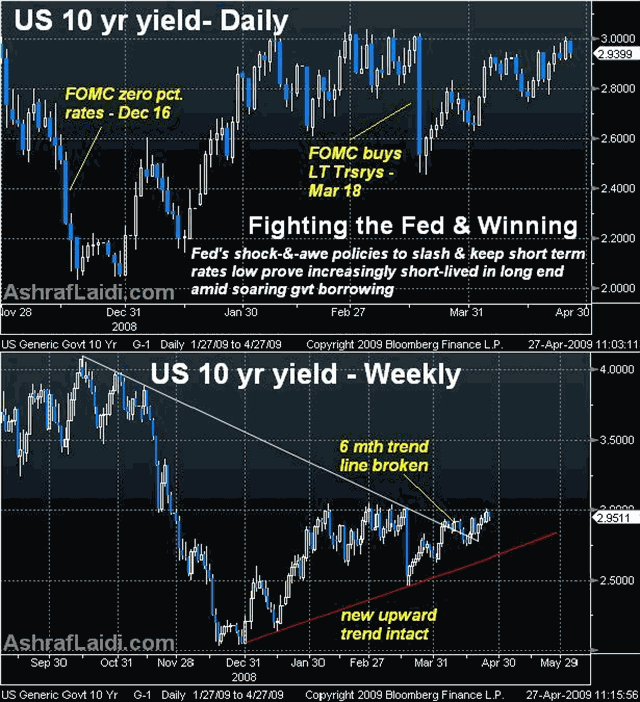


With the US Treasury estimated to borrow about $3 for each $1 purchased by the Federal Reserve this year in long term paper and agency mortgage securities, supply will continue overwhelming demand, and so will the upward impact on bond yields. And as the US Treasury/Fed grows more sensitive to China's concerns with the repercussions of soaring US debt, stabilizing long term yields becomes more paramount than ever. The FOMC decision to buy up to $300 billion in LT treasuries at the March 18 meeting was a surprise due to the Fed's prevailing rhetoric at the time signalling no immediate need for such purchases. But when we consider the fact that Chinese Premier Wen Jiabao had stated earlier that week the need for the "...United States to honour its words, stay a credible nation and ensure the safety of Chinese assets..." the Fed decision becomes less of a surprise. Those comments had lifted 10 year yields for three consecutive days leading to the FOMC decision.

With the dollar sustaining strength against most major currencies, the Feds priority will remain geared at stabilizing bond yields without worrying about prompting a durable sell-off in the currency. The Fed hopes for well received auctions this week ($40 bln in 2-year notes Monday, $35 bln in 5-year notes, $26 bln in 7-year notes on Wednesday. Then right after the Wednesday decision, the Treasury will announce how much in 10 and 20-year treasuries it intends to raise.

Only to the extent to the that FOMC announcement succeeds in dragging down bond yields will the decision weigh on the US dollar to the benefit of gold. The chart below illustrates that the inverse correlation between the gold and yields had intensified earlier this year as markets began to anticipate the Feds purchases of LT treasuries, which helps gold via a deepening of credit easing and dollar declines. The daily correlation since April 1st was a significant -0.62, compared to a merely -0.27 since January and -0.09 since September.
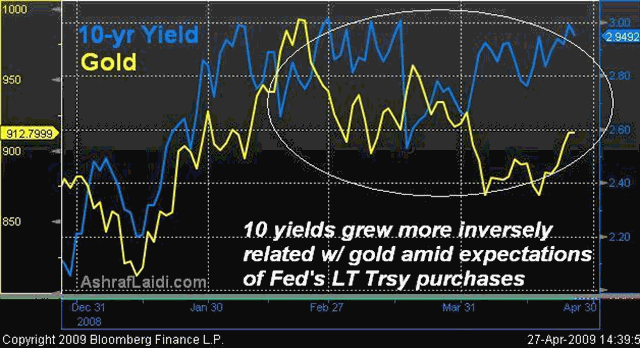
Considering the upward movement in global bond yields, this weeks US auctions and growing signs of stabilization in some economic data sets, the FOMC will have to pull another shock-&-awe announcement on Wednesday to bring down yields. Anything short of that, the dollar could resume its upward momentum against risk currencies (non-JPY), while gold is likely to be caught up between the negative effects from a rising dollar and the positive impact from a falling stock market. Hence, absence of aggressive Fed action could once again dissipate the inverse gold-treasury relationship (both move higher), especially as stocks set to start their upcoming 2-month down cycle

P.S. Gold tests the top of the trend line resistance extending from Feb 20. The peak of the line has been reached at 1-month intervals (Feb 20, Mar 20 and Apr 27), looking to test $940 by mid week.


 
    Comments By Users (42)   (View All Comments)    Post a comment

London, UK

May 7, 2009 16:25 ET
Mikestiller, not sure about GS and JPM but it’s very possible. At least according to some “insiders” out there.

ECB is not doing quant easing. Even FED is technically doing ONLY CREDIT EASING. Once you start targeting quantity of money out there then its called QE. i.e. Japan back in 2002-4.

Rob, to hedge long cable would be to LONG USDCAD or SHORT NZDUSD or long EURGBP

Ashraf
Rob
New York, US

May 7, 2009 15:27 ET
Member since Jan 2009
Hey Ashraf,

Any thoughts on those who are long GBP/USD other than going long EUR/GBP - it's seems to want to hold support at 1.5000 -
How do you feel about the PPI numbers for the UK? Do you think that will have any significant impact, or should we just keep our fingers crossed that stocks recover?
Thanks for your help!
New York, US

May 7, 2009 09:30 ET
Member since Mar 2009
Also, do you think what ECB is doing can be considered QE? Trichet says "we are not embarking on quantitative easing." Just curious on your thoughts. Thanks
New York, US

May 7, 2009 08:15 ET
Member since Mar 2009
Do you supposed JPM and GS are stuck short gold and silver by overlending it. Buying calls to make up naked exposure? Thanks
London, UK

May 6, 2009 13:37 ET
Nick, no way to know how deep the initial pullback, but i still see a testing of the March low with 70% chance to fall below it. as for your stopsm, it depends on your reward/risk ratio and your intended limit. Your AUDUSD stop may be a too low.. how about at 0.7520. and cable stop coul dbe around 1.5200.

Ashraf
New York, US

May 6, 2009 11:40 ET
Nice CNBCW interview this morning. I was able to catch most of it.

Based on your analysis you seem to think the market is starting to roll over here. My question to you is this. After the typical bear market rally of 30% or so, what was the average retracement subsequently?

Are we supposed to touch the bottoms again? Retrace to a certain fib?

Finally, I am looking at 4 pairs and wanted to know what you think?
GBP/USD: Short with a stop at 1.5140
AUD/CAD: Short with a stop at 88.34
CAD/JPY: Short with a stop at 85
AUD/USD: Short with a stop at 75

Thanks for you insight.
Rob
New York, US

May 6, 2009 10:51 ET
Member since Jan 2009
Hey Ashraf,

Any thoughts on BoE and ECB interest rate decision would be greatly appreciated! Thanks
London, UK

May 5, 2009 11:38 ET
houram, 1.17 on USDCHF is very possible at the next downturn in stocks. Weekly chart shows trend line resistance at about 1.1750s

Ashraf
Vancouver, Canada

May 5, 2009 04:10 ET
Member since Jan 2009
Hi Ashraf,
Do you think 1.17 could be a near term target for USDCHF?
Thanks
Houram
f
Brussels, Belgium

May 4, 2009 14:23 ET
Member since Mar 2009
incredible, it just can't manage to break the 1.50... maybe upcoming economic news will give it some final direction.... but it is pushing up consistently!

    32 more comments...

You must be signed in to post comments.
 
   
Subscribe to Ashraf's Newsletter
Email:


Analytics

 
Hot-Chart - Dec 13
Where to for Gold & Silver?   Our Premium subscribers may not be surprised by the $100 decline in gold over . more..
 
Forex Charting
Forex Charts Powered by Forex Pros - The Forex Trading Portal.
 
 
Ashraf's Book:

Currency Trading and Intermarket Analysis
How to Profit from the Shifting Currents in Global Markets [read more..]
[buy now]
 
Tag Cloud (Top 20)

 
Interest Rates
US0.25%
 
JPN0.10%
 
EUR1.00%
 
GBP0.50%
 
CHF0.50%
 
AUD4.25%
 
CAD1.00%
 
NZD2.50%
 
NOK1.75%
 
 
Intraday Market Thoughts

2012.02.03: The strength of todays jobs report and services ISM attained the rare pattern of triggering a USD rally despite broad advances in US equities. The risk-on-risk-off rule of punishing the US currency during rallying equities does not apply when good

2012.02.03: UK PMI services strong; Eurozone retail sales declined; employment in Canada lower than expected and unemployment rate rose; estimates for 2/29 LTRO. Key event for NY is NFP followed by ISM non manufacturing. There are 5 already CAD shorts in the

2012.02.03: The yen and dollar are higher as risk trades are pared heading into US employment data and the weekend. The Australian dollar is lagging. Chinas services PMI fell in January in a tentative, but premature, sign of a cooling economy. Eurozone-wide and


Copyright 2008 © Ashraf Laidi.     Webmaster: | Privacy Policy
Loading...