


Time Zone: ET | GMT
ARTICLES INTRADAY
MARKET THOUGHTS
ANALYTICS FORUM BLOGS  NEW MEDIA ZONE BOOK USEFUL LINKS  


Euro's Dead Cross

January 19, 2010 by Ashraf Laidi
(146 comments)
Print Share/Bookmark

Euro's Dead Cross (or Achilles Heel)

EURUSD's 50-day moving average has now fallen below its 100-day MA, which is referred to as a dead cross. As shorter duration moving averages (faster gauges of trend) move below their longer duration averages (slower gauges of trend), a downtrend is said to be confirmed. Momentum traders, trend-followers and black box programs will tend to trigger fresh moves as these major moving averages upon the trigger.

The last two occasions when the EURUSD's 50-day MA fell below its 100-week MA with the 200-day MA remaining below both trend lines was in Jul 2008 and March 2005; which preceded a 21% and 11% decline in EURUSD respectively. Fundamentally, the March 2005 cross-over occurred in the same year as when France and the Netherlands rejected referendums calling for closer integration with Brussels. Those dynamics were no different from the current Eurozone uncertainty involving Greece as well as the rest of Southern Eurozone members. This supports our $1.38 view for EURUSD by mid Q1 first communicated on Jan 5th
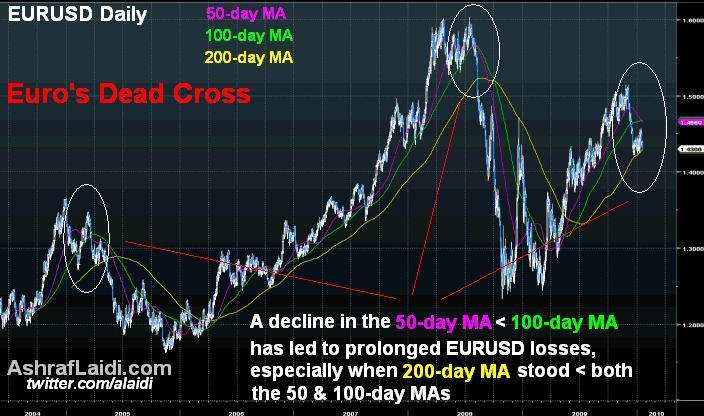
The combination of Greek-driven fiscal gloom and the 4th consecutive monthly decline in German ZEW investor sentiment survey is providing its share of fundamental woes for the single currency. Both the ZEWs expectations index for Germany and the Eurozone fell further below their 3-month moving averages in January. Escalating questions on whether the ECB and the European Union will grant it assistance to meet its short term debt obligations of EUR 53 bln this year was a sufficient excuse for probing the elusive 200-day MA of $1.4280. The lack of first category economic releases this week from the US and the Eurozone will give way to the round of earnings releases from the major US banks, which will influence overall risk appetite and the US dollars recently improving foundation.

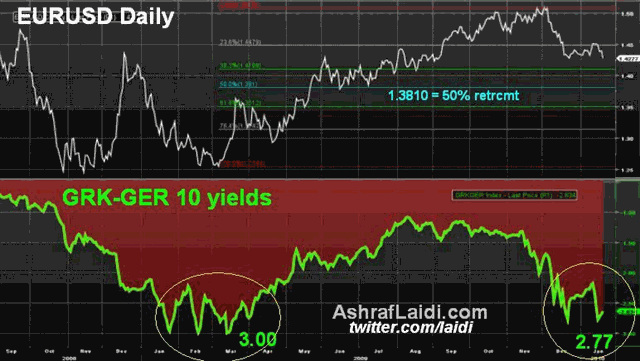
The chart below shows the resurging credit stress as measured by the widening spread between Greek and German 10-year yields, which has widened to 277 bps (2.77%), beating the high from November and matching the high in March.
GBP advanced on a combination of 9-month highs in UK CPI (2.9% y/y from 1.9% in Nov), Krafts imminent takeover offer for Cadbury (anticipation of M&A-driven flows) and a report from Goldman Sachs predicting the UK will outperform major economies in 2010. The stronger than expected CPI is in line with the Bank of Englands November inflation report, which predicted a short-term bounce in inflation, thus forming the MPC basis for its decision to increase QE by only 25 blnd espite deepening recession in Q3.

Sterling eyes $1.6480 as the next challenge--61.8% retracement of the decline from the Nov 17 high to the Dec 30 low--which requires a close above this level to prolong advances into $1.66. FX also watching yields on 10-year gilts as they seek to retest the 3.07% resistancetrend line from the Dec 30 high. We remain ambivalent with sterling's rebound until a more convincing recovery emerges past the $1.6480 barrier. In the meantime, downside risks remain for $1.6280.

Mind China's Double Digit Growth Markets may start witnessing shades of 2007, when strong Chinese figures led to market jitters on the grounds of accelerating tightening from the PBOC. Thursdays release of China Q4 GDP is expected at +10.3%, which would further justify broader tightening from the PBOC --such as raising the actual lending rates (beyond higher bond yields and increased reserve requirements). Such justification would cast a pall on the principal source of global commodity demand, starting with metals, followed by energy.

Gold's muted performance has not only resulted from the USDs improved foundation off its 55-day MA of 76.30s (now trading at 77.50) but also from the creeping uncertainty ahead of US earnings reason. No longer will US corporations be comparing their earnings to weak performance quarters, which will raise the bar as far as generating revenues-- besides just cost-cutting. Hedge funds and real money asset managers have already curtailed their net longs in gold as USD strength was fed by unwinding of shorts as well as fresh USD longs. The ensuing wedge (triangle in daily gold chart) suggests 1,145 as an interim resistance, with the downside risks seeking to test 1,11023.6% retracement of the fall from the 1,225 high to the 1,074 low.

Follow me on twitter http://twitter.com/alaidi for more frequent market updates

And If you like the +100 articles over the past year, +1500 IMTs, +60 HotCharts & +6200 tweets since May related to FX & Intermarket analysis, then please consider voting for me in the #finance category in this years Shorty Awards, where Im currently ranking 2nd out of +350 candidates. http://shortyawards.com/alaidi THANKS !


 
    Comments By Users (146)   (View All Comments)    Post a comment

kartitsch, Austria

March 22, 2010 06:32 ET
Member since Feb 2010
Merkel just pointing out fear of dramatic loss of domestic consum this year
London, UK

March 22, 2010 03:11 ET
Mandi, See these latest polls showing rising german opposition to greece aid; euro http://bit.ly/dg1XtH

Ashraf
Austria

March 20, 2010 05:35 ET
Ashraf please also have a look at recent statistical costs of labour per output

Greece 32,8 %
Italy 31,4 %
Spain 30,1 %
ireland 27, 3 %
Germany 5,8 %

http://fbkfinanzwirtschaft.files.wordpress.com/2010/03/bw-march-1_2010-merkel-germany-vs-europe.pdf

these figures reflect also, which nations are waiting in the queue next to be "supported" or "aided" or
"honoured" for their inabilties
kartitsch, Austria

March 20, 2010 03:11 ET
Member since Feb 2010
Ashraf, besides, for me Greek CDS will fuel the risks tremendously
How shall the Greek pay the debts ? you already made critical marks about that, I know

so Greek CDS will be not the solution, but the prolongation of the crisis:

cheap money was the decisive harmful Katalysator for the subprime crisis and will it be now again.
kartitsch, Austria

March 20, 2010 02:45 ET
Member since Feb 2010
Ashraf, I would like to explain to you the most weighing problems of german economy for me. Germany shows an ancient population (over 30 % now are older than 60 years) and Harz 4 is leading into the wrong direction. Did you know that in January 2010 6,5 Mio people got Harz 4 transfer support, 1,7 Mio children under 15 years must live from this transfer. 15 Mio people with migration backgrund compensated falling birth rates since 1970 until now; The population in Germany - acording to forecasts -will shrink in the next years from 82 Mio to 74 Mio (or 60 Mio) with alwas less children and more old people.

For these reasons I d`ont belief Germany can afford so much to bailout Greece
kartitsch, Austria

March 18, 2010 02:19 ET
Member since Feb 2010
Ashraf, there we are - no glimpse of any possibility for German loan guarantees for Greece, they rather expel greece from the EMU; I dont think the markets belief, Greece will execute their austerity program in a proper way and cannot gain confidence back.
If this is presumably so, Greek will also destabilze confidence in the Euro anyway with or without aid.

Germany or the EU can help temporarily but not change greek structures and manners (behaviours)
kartitsch, Austria

March 17, 2010 03:40 ET
Member since Feb 2010
Xaraon

Sie wissen doch selber am besten Bescheid ber die derzeitige Stimmung in Deutschland; der aufmacherische Film "die Grenze" und Umfragen enthalten zumindets ein Krnchen Wahrheit

Mit der Piefek Saga oder Seitenhieben auf sterreich allerdings nicht vergleichbar

Aber im Ernst: Meine Bemerkung betraf die Frage, ob Deutschland Griechenland helfen wird, davon war ich nicht berzeugt und Finanzminister Schuble hat dies kurz nach meinem Beitrag auh deutlich besttigt und von gezielter Fehlinformation gesprochen.

Ich wollte zum Ausdruck bringen, dass Deutschland auch wichtigere Sorgen als Griechenland hat.

Germany

March 17, 2010 02:19 ET
mandiwie you must be kidding! We germans do NOT want back that stupid wall. Before that happens Austria would join Germany again. ;) Just kidding...
kartitsch, Austria

March 17, 2010 02:11 ET
Member since Feb 2010
Ashraf, i was completely right with my doubts about german aid

Schuble yesterday spoke about deliberate false informations for speculators

http://www.ft.com/cms/s/0/7bab9d7e-3128-11df-8e6f-00144feabdc0.html
London, UK

March 16, 2010 18:21 ET
Mandi, if they wont give them any loan guarantees then surely no bailout.

Ashraf

    136 more comments...

 
Post a Comment/Response to this article
Enter you email/password:
Email:
Password:
Post without signing-in
Write your comment below
Attach Chart
 
   
Subscribe to Ashraf's Newsletter
Email:


Analytics

 
Hot-Chart - Jul 28
GBP Getting Best of Down Under   GBPAUD reflects contrasting expectations . more..
 
Forex Charting
Forex Charts Powered by Forex Pros - The Forex Trading Portal.
 
 
Ashraf's Book:

Currency Trading and Intermarket Analysis
How to Profit from the Shifting Currents in Global Markets [read more..]
[buy now]
 
Tag Cloud (Top 20)

 
Interest Rates
US0.25%
 
JPN0.10%
 
EUR1.00%
 
GBP0.50%
 
CHF0.50%
 
AUD4.50%
 
CAD0.75%
 
NZD3.00%
 
NOK2.00%
 
 
Intraday Market Thoughts

2010.09.03: RALLYING LOONIE accumulates gains post-US jobs, amid positive impact on Canadas economy from stabilizing US dynamics, and the rationale based on the fact that Canadas overnight rate remains below 1% and faces higher upside than any of the commodity

2010.09.03: MARKETS CHEER AUG US JOBS REPORT as payrolls fall by smaller than expected 54K and the unemp rate rises to 9.6%. More striking is the July figure was revised down to -54K from -131K, while the private payrolls rose by 67K vs exp 41K following 107K

2010.09.03: Ashraf's Video for Reuters Thomson illustrating the similarities of the interest rate cycles between the Fed and the Bank of England and QE2 by the Fed will lead to the same by the BoE http://bit.ly/ 9VAefQ


Copyright 2008 © Ashraf Laidi.     Webmaster: | Privacy Policy
Loading...