


Time Zone: ET | GMT
ARTICLES INTRADAY
MARKET THOUGHTS
ANALYTICS FORUM BLOGS  NEW MEDIA ZONE BOOK USEFUL LINKS  


Eurozone Core, USD Index & Swiss Knife

June 11, 2010 by Ashraf Laidi
(37 comments)
Print Share/Bookmark

The 1.2% decline in US April retail sales deals a rude awakening to the low-volume rally in equities as well as the recent bounce in the euro. Just when EURUSD was attempting to make its 4th daily increase (EUR hasnt had more than 3 straight daily gains since December), the risk aversion stands in the way. EURUSD would have had to close Friday above $1.21 in order to overcome its inability to post 4 consecutive daily gains this year. Once again, this won't happen. And despite Fitch positive remarks on Hungary, stating that the central bank has sufficient funds to cover its financing needs into the rest of 2010, the euro continues to struggle below $1.21. But the impact of risk aversion on the single currency has extended losses towards a prelim target of $1.2040 (morning report to clients). Frequent readers of my analysis and followers on twitter are familiar with my $1.1650 target in EURUSD. Todays failure to regain $1.21 is another step into that objective.

EURUSD The only time when we saw the opposite of the above situation i.e. (rising euro, falling stocks and falling gold) was three weeks ago, when Chancellor Merkels ban on naked short selling, prompted the Swiss National Bank to intervene aggressively. As a result, EUR rallied across the board, dragging gold against it (and rest of currencies), while global equities sold off. We expect the single currency to head back below the $1.1870 later this month, before calling up our interim target of $1.1660. Selling the rallies remains the name of the game, only this time, the rebounds are short-lived and the reasons to attack core-nations more plentiful.

Attacking the Core

If we get more days like June 7-8, then the Eurozone area may be unfolding into a mini-contagion. Selling is intensifying in the bonds of core Eurozone nations as the yields on French and Italian government bonds soar relative to their German counterparts. French-German 10-year spreads have doubled to 57 bps in less than a week to reach their highest since March 2009, while the Italian-German 10-year spread hit a euro-life time high of 179 bps. Spains 10-year spread with Germany hit 214 bps and is expected to surpass the 250-bp mark.
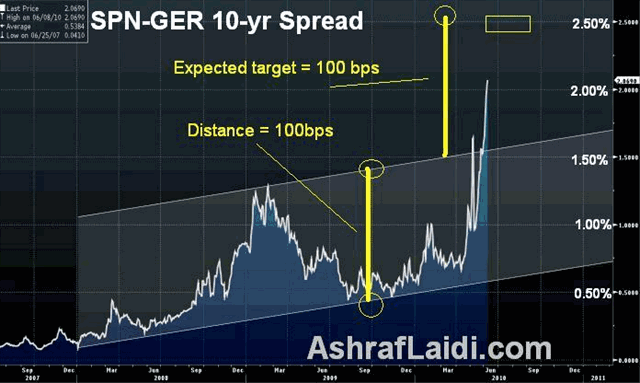
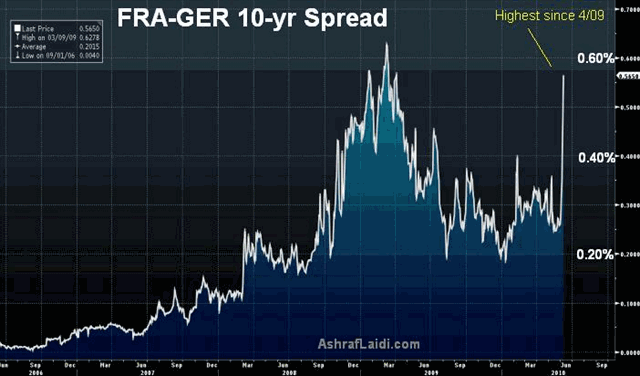
One striking component of the attacks on core nations' bonds is that spreads in Greek and Portuguese bonds are less than half their May highs of 1000-bps and 350-bps respectively. Such are the embryonic signs of a contagion, which prompts traders to force the hand of healthier sovereign bonds. Rumours of substantial derivatives losses at Societe Generale and of an Italian downgrade were unsubstantiated but are far from impossible. The more immediate danger is the reality that French banks account for half of the EUR 76bn in Greek debt lent by the Eurozone, with German banks accounting for about a quarter of that.

USD Index Eyes Record Gains
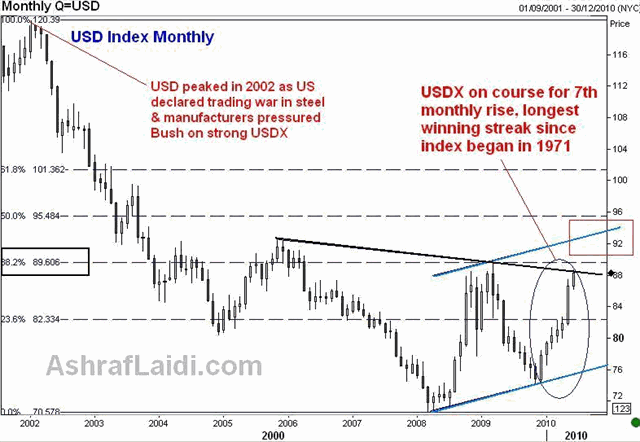
The US dollar index is set to post its 7th monthly consecutive increase, the longest winning streak since the history of the 39-year old index. The USDX is basket of 6 currencies (EUR 57%, JPY 14%, GBP 12%, CAD 9%, CHF 4% and SEK 4%). The chart below shows the USDX is testing the trend line resistance at 88.10, extending from Jan 2006 high. More importantly, right above it, is the 88.60-70 resistance, which is the 38% retracement of the decline from the February 2002 high to the March 2008 low. This level also coincides with the March 2009 high (stocks bottom). A double top in USDX would likely emerge by fresh dosage of Fed-driven liquidity boost and a resulting equity rally. A break above 90 would encounter preliminary resistance at 92, until the key obstacle of 95.50 stands out. Bear in mind that a break above 90 is a price equivalent to sub $1.1700-1.1650 in EURUSD.

Setting euro price action aside, non-USD currencies remain handicapped as long as the elusive 200-day MAs in S&P500 (1107) and Dow-30 (10309) are not breached. Both levels have acted as key obstacles since May 20, coinciding with fading gains EUR, AUD and other risk currencies. Speaking of AUDUSD, the pair remains unable to regain the 0.8550 resistance since May 19, which failed at 3 occasions (May 28, June 3 and June 11). Selling the rallies at 0.8540-50 in AUDUSD is equivalent to the double top in NZDUSD at 0.6890. I continue to expect a retest of 0.8410 trend line, before 0.8280 emerges as interim foundation.

Swiss franc Knife Still Sharp

Aside from the strikes in Spain protesting the barely passed austerity policies, increased evidence of the Swiss National Banks failure to follow through on its euro-supporting interventions is adding to the losses in the euro. EURCHF knifed through new record lows of $1.3740, 10% below the so-called line-in-the-sand from last May of last year. Recent Swiss data has shown decent figures, including a 2.2% annual increase in Q1 GDP growth. Consequently, markets anticipate a more passive SNB, which only exacerbates the sell-off in EURCHF. But rather than chasing the pair below 1.35, it is more viable to use CHF longs against USD to hedge out the risk aversion longs in the US currency. This is also supported by the struggling weekly USDCHF chart, whose technicals increasingly suggest 1.1080 to be a reality before summer end. Reconciling a struggling USDCHF with a drifting EURUSD implies renewed downside for EURCHF. But dont rush into selling EURCHF below 1.40. The weekly chart appears oversold, which suggests another 200-300-point bounce before downside resumes.


 
    Comments By Users (37)   (View All Comments)    Post a comment

London, UK

July 12, 2010 15:07 ET
Chance, Not nuch chance for 1.12 in USDCHF. I said many times on this site, buying USD is preferable when done selectively against EUR, AUD and GBP but not necessarily against CHF.

Ashraf
tripoli, Lebanon

July 12, 2010 06:55 ET
what is ur opinion now after one month of ur article? will the pair be buoght again and reach 1.12 on the long term?
London, UK

July 6, 2010 15:41 ET
Member since May 2010
Niall Ferguson Rips Paul Krugmans Policy Reccomendations

http://www.youtube.com/watch?v=_nRLiZrkHEY&feature=player_embedded#!

Niall Ferguson of Harvard University spoke with Bloomberg Television on the subject of bond markets and the threat of a speculative bond attack against the United States.

0:35 Bond vigilantes are similar to those who were shorting invest banks a few years ago. They will keep climbing the quality of countries, similar to how they did with banks.

1:35 There is no example in history of any country growing out of this sort of debt position, except for Britain in the early 1800s, which had empire and industrial revolution on its side.

2:10 What is worrying is that there is no inflation, which is the easy way out of this sort of financial situation. Default now seems the only escape, and the U.S. may choose that path with unfunded liabilities like Social Security.

3:00 Nothing would scare the market more than if the government followed Paul Krugmans call for more stimulus.
London, UK

July 6, 2010 15:36 ET
Member since May 2010
Banks Dont Pay Taxes; People Pay Taxes

The fate of the financial reform legislation in the Senate apparently depends on whether it contains a tax increase. The conferrees hastily re-convened to remove one tax objected to by Senator Brown. Okay. That was a good move. But lets not forget a couple of basics: (1) the imposition of massive new regulations on the banking and financial system will raise costs that may not be called taxes, but will have a similar effect. (2) the incidence of that cost-tax probably wont be what was intended. Banks, like other businesses, will likely pass most of the additional cost onto their customers.

http://taxesandbudget-blog.ncpa.org/
July 3, 2010 18:26 ET
Member since Jul 2009
Hi Ashraf, Where do you see the USDCAD ....headed towards 1.30?
Abingdon, UK

July 3, 2010 04:47 ET
Member since Oct 2009
Well looking bck here, Catnip was the most accurate, although 1.27 by end June was not quite achieved. 1.27 may well yet be achieved though, although it was running out of steam by the end of Friday. I have to say that at the time I was sceptical about 1.27, but I have to doff my cap to you.
Now to see if the 2nd half of your prediction will come to pass - i.e. a drop to 1.16 in July.
I hope so!
Kuwait

July 2, 2010 18:58 ET
Member since Jan 2010
Hi Ashraf,
Double-Dip Recession in the US .. what do you think ??
London, UK

June 22, 2010 05:48 ET
Member since May 2010
The Falling VIX Is Forecasting A Huge Chance For Gains

Could the latest activity in the Volatility Index (VIX) be signaling a month of decent returns? According to Market Tells, yes, via The Daily Options Report: http://dailyoptionsreport.com/blog/post/the-vix-dip-may-be-telling-you-something/

One of the more noteworthy developments last week was the persistent decline in volatility. For only the second time in the last five years, the OEX Volatility Index (VXO) posted nine consecutive lower lows as of Fridays close. This type of definitive drop in volatility has usually led to a flat-to-up market over the intermediate-term. Just looking for eight consecutive days of lower lows only turns up 10 occurrences since 1986

Eight Lower Lows for VXO

06/17/10 S&P500 ???
07/20/09 S&P500 +5.4% two weeks later, +3.0% one month later
06/21/05 S&P500 -1.5% two weeks later, +1.8% one month later
04/16/03 S&P500 +4.1% two weeks later, +7.6% one month later
11/23/01 S&P500 +0.7% two weeks later, -0.5% one month later
10/03/01 S&P500 +0.5% two weeks later, -1.2% one month later
11/19/90 S&P500 +2.2% two weeks later, +3.4% one month later
06/20/89 S&P500 -0.2% two weeks later, +4.5% one month later
12/23/87 S&P500 -3.9% two weeks later, -2.6% one month later
12/24/86 S&P500 +4.9% two weeks later, +9.5% one month later
10/23/86 S&P500 +2.8% two weeks later, +1.2% one month later

While Europe Is Back In Focus And It's Whacking Global Stocks

The most noteworthy point is the overall theme of limited downside potential over the next month. The S&P was up 3% or more one month later in 5 out of 10 occurrences and was never down more than 3%.

After yesterday's yuan revaluation rally, Asian markets have lost steam just like U.S. ones did at their close yesterday. Asia as a whole is down about 1%, with some relative strength in Shanghai.

MSCI Asia Apex 50 -- -1.1%
Hong Kong's Hang Seng -- -0.5%
Shanghai's CSI 300 -- +0.1%
Japan's Nikkei -- -1.2%
Australia's ASX 200 -- -1.2%

European markets are sliding. Bloomberg blames the action on a European Central Banker official
warning that European banks will have trouble funding themselves.

Major European markets are lower by 0.2 - 0.6%:
U.K.'s FTSE -- -0.6%
Germany's DAX -- -0.2%
France's CAC 40 -- -0.5%

Gold has eased back from it's new high, and is at $1,239. The euro has fallen back to $1.2316. Spanish ten-year bond yields are rising again, after having eased back from 2010 highs over the last few days.

Steel And Copper Consumption Are Breaking New Highs, But China Has Traders In A Stranglehold

Worldsteel data, shows how global steel production has returned to record levels.
Global copper consumption has staged a similar recovery, with the mix in consumption now more tilted towards China and less from the rest of the world.

Metal Miner:
The bank [Credit Suisse] states that commodity demand is back to where it was in volume terms before the crash of 2008. For example in 2007 the world consumed around 18mt copper split 5mt China 13mt ex China. Now its around 7mt and 11mt same global size very different split. Globally, steel production is back to pre-crisis levels but again capacity under utilization in the west has been compensated by significant new capacity running at higher levels in Asia.


Metal Miner highlights an interesting point -- Despite the fact that global steel production has returned to record highs, the change in mix really hurts producers in developed markets who are still suffering from massive capacity under-utilization. Steel can be shipped, but it's not quite a global market like its raw materials (iron ore and coal) are. Thus it remains very much split into regional markets. Credit Suisse makes the argument that investing in mining companies is thus the better way to play global commodity consumption, rather than dealing with steel companies.
London, UK

June 18, 2010 11:38 ET
Member since Jun 2009
EURCHF hits 1.371...swiss tourists must be v happy
Saida, Lebanon

June 17, 2010 19:07 ET
Member since Jun 2010
Hi Ashraf I like your way.
Enjoy worldcup.

    27 more comments...

 
Post a Comment/Response to this article
Enter you email/password:
Email:
Password:
Post without signing-in
Write your comment below
Attach Chart
 
   
Subscribe to Ashraf's Newsletter
Email:


Analytics

 
Hot-Chart - Sep 6
AUDCAD Where to from here?   AUDCAD has rallied 12% from its June lows as . more..
 
Forex Charting
Forex Charts Powered by Forex Pros - The Forex Trading Portal.
 
 
Ashraf's Book:

Currency Trading and Intermarket Analysis
How to Profit from the Shifting Currents in Global Markets [read more..]
[buy now]
 
Tag Cloud (Top 20)

 
Interest Rates
US0.25%
 
JPN0.10%
 
EUR1.00%
 
GBP0.50%
 
CHF0.50%
 
AUD4.50%
 
CAD0.75%
 
NZD3.00%
 
NOK2.00%
 
 
Intraday Market Thoughts

2010.09.07: Ashraf is featured in today's Financial Times' "View of the Day" (page 35) http://twitpic.com/ 2m3c60 disussing central bank easing, precious and base metals.


2010.09.07: YEN STILL DOING IT as the mere sign of profit-taking in global bourses, sends yen crosses falling across the board. AUDJPY proved once again unable to break the trendline resistance of 77.70s, extending from the June 21 high. And with AUDJPY Daily

2010.09.07: BACK TO SCHOOL & RISK AVERSION as Asian stocks dip back into the red; Jullia Gillard keeps power for Australias Labour Party thanks to the backing of 2 independents. Though her tax on resource makers is a watered down version of her predecessors


Copyright 2008 © Ashraf Laidi.     Webmaster: | Privacy Policy
Loading...