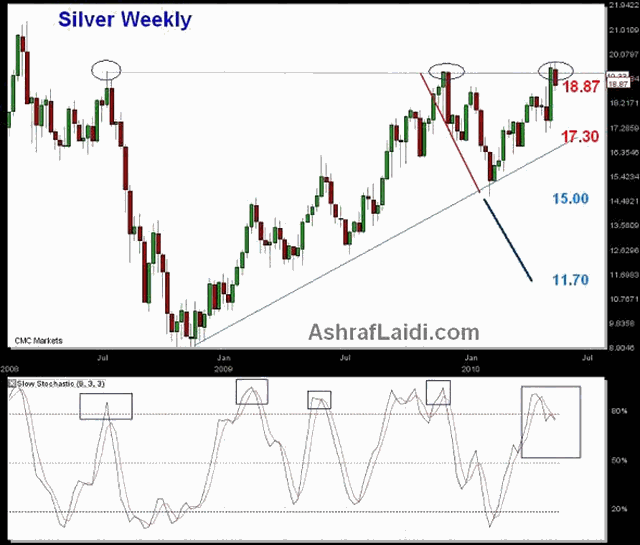



FX Interventions, Aussie & Gold
Since neither the 750 bln IMF/EU/ECB package nor Germanys announcement to ban naked shorts succeeded in alleviating selling in the euro, coordinated central bank intervention to support the single currency is inevitable. Such action will unlikely reverse the euro's slide, but may help resurrect a 2-way market in the currency and slow down the damage.
It took only 2 days for the ECB to make an about-turn on bond-purchases and for Berlin to institute a ban on naked shorts. The authorities are running out of ideas and defences. I noted in the May 4 article "1999 & 2010 similarities in USD" that the euro's woes are very similar to 1999, when the ECB made a series of U-turns regarding monetary policy.The ECB decision to purchase government bonds confirms the striking similarities with 1999 with respect to the obstinate central banks position against quantitative easing. During the first 3 months of 1999, the ECB was persistently harangued by Eurozone finance ministers for following its dual pillar policy (CPI and M3 targets) at the expense of sending its economy back into recession following the 1998 Asian crisis. It didnt take long before the ECB made a U-turn in April 1999 to start a series of rate cuts. The euros losses were accelerated when the Fed began its tightening cycle 2 months later.
Another similarity is the apparent cracks within the cohesive European Central Bank's Governing Council. It has been revealed that ECB chief economist Jurgen Stark and Dutch central bank president Nout Wellink voted against the decision to buy bonds. Such lack of unanimity became rare since JC Trichet took over the presidency in 2003. This was in contrast to 1999, when national central bank governors and finance ministers contributed to a cacophony of statements on the euro, which eventually led to the late ECB head Wim Duisenberg to say: "I am Mr. Euro"
Euro Longs to Remain Naked
Losing 16% against USD year-to-date, EUR is the second worst performer out of a group of 36 major currencies (after the Hungarian forint). The factors justifying the attack on the euro started off in December with sovereign credit downgrades, before intensifying into the ECBs about-turn with respect to buying Eurozone bonds.
Todays intervention by the Swiss National Bank to propel EUR higher vs. CHF by a remarkable 300 pips (3 centimes) forced FX traders away from selling EUR & GBP against USD and JPY and into selling the higher risk commodity currencies (AUD, CAD & NZD). While it is about time for the euro to stage a decent corrective bounce beyond a few hours (has not had 3 consecutive daily gains since March), I still expect the eventual break of $1.2140 to give in to $1.17 before summer end, while seeing a 70% chance for $1.10 before end of Q3.
Unless the German ban on naked CDS shorts is instituted on a European or global level, its effectiveness will come up short. Unlike equity markets, credit default swaps are traded privately, and not on exchanges. And the fact that the bulk of these markets are in NY, the German ban will do little to prevent shorts from trading outside German shores. Also, according to the Deposit Trust & Clearing Corp (CDS clearing agency), outstanding CDS on most Eurozone sovereign debt does makes up less than 1% of the entire CDS market, estimated at $11 trillion. Chancellor Merkel's unilateral ban is an ad-hoc measure that partly aims at containing her declining popularity following her Partys defeat at last weeks regional election. Unless similar measures are adopted by the France, UK and US, these will prove to be no more than desperate politicians waging a losing war against speculators.
High Yielder, Highest Loser Down Under
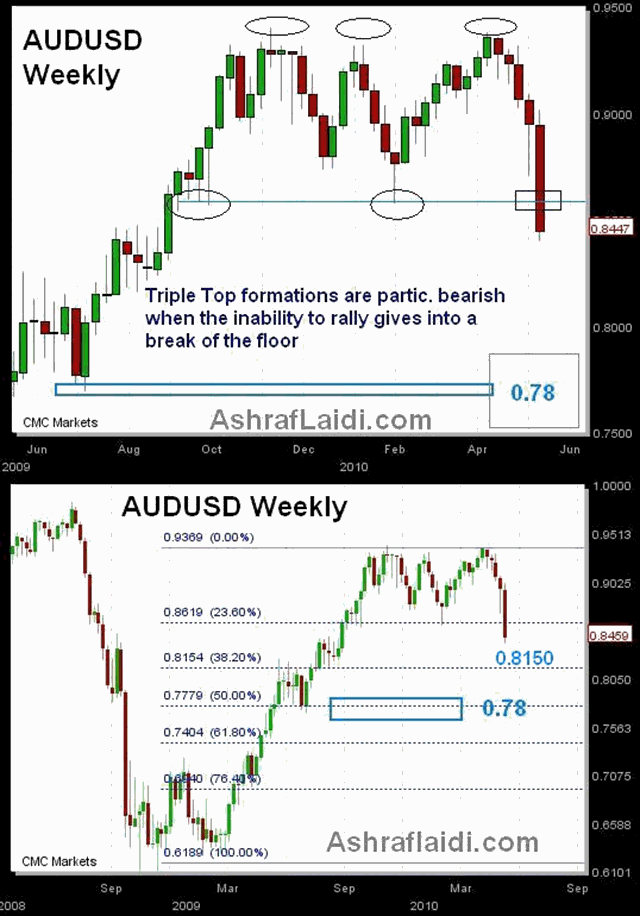
No, the euro is NOT the day's biggest loser since Tuesday's close, rather it is the Aussie, followed by the Kiwi and the Swedish Krone. The Aussie falls victim to its own success of higher yields, which are especially under scrutiny after the RBA hinted at a pause in its tightening cycle two weeks ago. Readers of my AUDUSD HotChart (Whats Next for the Aussie May 4th) and the recipients of the May 11th piece Endangered Aussie Carry were told that the latest sell-off in global equities has begun to unwind one of the few remaining carry trades in the non-emerging market FX space. Today, AUDUSD and AUDJPY lost 4.2% and 4.6% respectively.
The technical significance of last nights break below 0.8580 implies further selling of another 5% from current levels. The 0.8580 low was held in Sep-Oct 2009 as well as in Feb 2010. Last nights failure implies a decline to as low as 0.80 and 0.78, especially if no close above 0.86 is attained this week.
Gold Finally Responds to Falling Commodities
Gold is finally responding to a broad sell-off in commodities. This was not the case on May 6 when the 9% intraday plunge in equities saw gold shrug off selling in copper, crude and natgas. The latest 24-hours have witnessed less resiliency in gold, as the risk of deteriorating equities may force managers into selling their winners (accumulated gold gains) to meet their widening losses. If the aforementioned suspicions of coordinated euro buying by the central banks are confirmed, traders could begin unwinding of their GOLD/EUR shorts, thereby, exacerbating the recent selling in GOLD against other currencies. Gold drops 3% against EUR from its 1,010 record high. Further pullback towards 960s could call up $1,165-70, followed by $1,120.
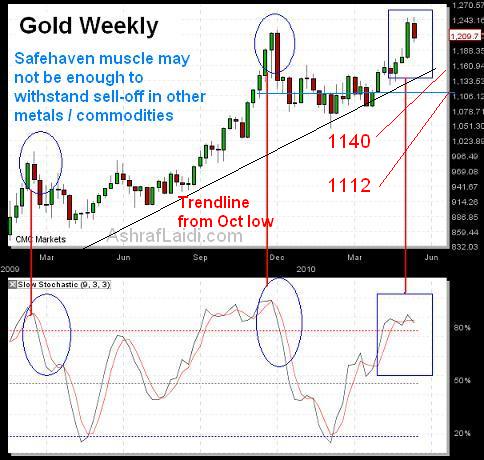
In order to understand this rationale, it is important to grasp the fact that the recent gold rally had initially emerged against EUR due to Eurozone sovereign woes, which led to multiple record highs in GOLD/EUR before the metal finally hit new highs against GBP, JPY and USD (in this order). Thus, any anticipation of coordinated intervention to support EUR may transition a decline in GOLD/EUR into GOLD/(other currencies)m which eventually allows the yellow metal to join the selloff in silver, oil and gas.