


Time Zone: ET | GMT
ARTICLES INTRADAY
MARKET THOUGHTS
ANALYTICS FORUM BLOGS  NEW MEDIA ZONE BOOK USEFUL LINKS  


Loonie's Falling Downside

March 2, 2009 by Ashraf Laidi
(22 comments)
Print Share/Bookmark

While the dollar and the yen continue to prove being the strongest currencies during falling equities, let's focus on the currency with the combination of past sell-off as well as prolonged downside ahead. The latest Canadian GDP report accentuates our recent notes highlighting the case against the Canadian dollar as the country produces deteriorating figures on growth, jobs and industrial production. Q4 GDP fell 3.4% annualized (first decline since 91) from +0.9% on Q3, while 2008 GDP rose 0.5% from 2.7% in 2007.
The report leaves little doubt as to the outcome of tomorrows Bank of Canada rate announcement (50-bp rate cut to record low of 0.50%). Markets are currently in debate as to whether central banks readiness (BoE and BoC) to launch credit easing will avoid taking rates down to zero. In mid-February, Bank of Canada Governor Carney hinted at quantitative easing, indicating that the Bank retains considerable policy flexibility, which [it] will use if required." With Canadian interest rates at 1.0% and inflation dipping to 1.1% y/y, well below the banks preferred target of 2.0%, the outlook for further rate cuts looms large, especially considering plummeting oil prices and the drag from the US contraction. The onslaught of record job losses (-129K decline in Jan) and the 6.4% unemployment rate at 5-year highs paves the way for prolonged dislocation, allowing for a 7.0% print to emerge before year-end.

Canada's eroding budget and trade imbalances are highlighted by the fact that the nation is slipping into its first budget deficit in 12 years and its first trade deficit in 33 years 1976 as falling oil prices and plummeting exports from the US eroded its external account. Since currency markets focus on relative values, the deepening deterioration in Canadas finances as well as the prolonged onslaught from the US recession is the key to the increased positive correlation between the Canadian dollar and the US equity indices. Those who argue that Canada's budget and trade imbalances remain far superior to those in the G-3 economies, a reminder suggests that FX markets focus on the relative changes rather than absolute levels in these macroeconomic variables.

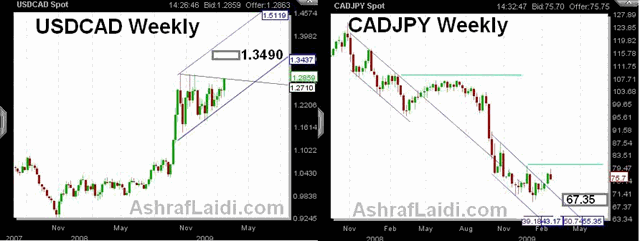
The Canadian dollar is increasingly correlated with shifts in risk appetite as the currencys heightened vulnerability to the US contraction and plummeting oil prices rendered it a high profile victim of rising risk aversion and a beneficiary of market bounces. Correlations in USDCAD (Canadian dollars per 1 US dollar) against the S&P500 and the DJIA edged up to -0.69 since the start of February, compared to -0.66 since year-to-date. The increase in correlation was similar for CADJPY, which is a stark manifestation of risk appetite as the loonie is gauged against the low yielding Japanese currency. Additional downside in equities (-15% from current levels) is likely to see USDCAD head beyond $1.30 and onto $1.3490s, while CADJPY is likely to breach below 72 and onto the 69.70s.
The Australian dollar fared as the best performing currency in February, followed by the pound and the US dollar, while the yen and Canadian dollar were the worst performers amid a group of 10 currencies. Year-to-date, the dollar retains the lead in FX returns, followed by the pound and the Norwegian krone, while the New Zealand dollar and the euro trail at the bottom.

Fundamentally speaking, the Australian dollar represents an economy that has fared better than most of its G10 counterparts, with a growth outlook far exceeding that of the G10 nations. Australias 2009 GDP growth is expected to reach +1.0% y/y, compared to -2.0%, -2.20%, -5.0%, -2.7% and -2.2% in the US, Eurozone, Japan, UK and Canada respectively. From a structural perspective, Australias current account deficit is seen at 4.4% of GDP in 2009, its lowest level since 2002. Its budget surplus is expected to hover at 1.0% of GDP--a far superior display than the deepening deficits of the US, Eurozone, Japan and the UK.

Norway, the other commodity currency, whose structural situation is boosted by a hefty current account surplus standing at 5% of GDP (biggest in industrialized world) and a budget deficit of less than 2.0% of GDP. Chapter 8 of my book highlights the Norwegian Krone's outperformance relative to other energy currencies (Canadian dollar, Russian ruble & Mexican peso) during the following periods Jan 2000-May 2008, Jan 2002-May 2008 and Jan 2007-May 2008.

I have argued the case for for 5,500 in the Dow and 550-60 in the S&P500 before end of Q3 based on the interaction with interest rates, gold and oil. The economic and banking case is also supportive. The FX implications for such an outlook are likely to carry prolonged gains in the yen and the dollar (despite weak Japanese fundamentals) but CAD weakness will be here to stay.


 
    Comments By Users (22)   (View All Comments)    Post a comment

London, UK

May 4, 2009 13:08 ET
trond, i dont follow those stocks.

Smundy, USDCAD selloff is intense. It could go to the 1.1670 low if S&P can close above 900. 1.1450 is the next target if you think the bear market is over.

Ashraf
Canada

May 4, 2009 12:06 ET
Ashraf,

Based on my previous analysis posted on April 9th, it does look as if the Canadian has in fact broken out to the downside. With the Negative correlation between Equities and the Canadian, I can see a test against a low set back on Jan 6th 2009 at 1.1755, which it hit this morning. However, due to the continued run up in equities and the target of 950 looming (S&P), this support level may be a wet paper bag, thus pushing the Canadian down to the 1.1530 Fib level. With a possibility of hitting the low set in November 5th 2008 at 1.1458. Your feed back in much appreciated.

Thanks
Oslo, Norway

April 15, 2009 02:44 ET
Member since Mar 2009
I have some shares in Canadian copper and mining companies on the new york and amex stock exchange. Are there any Australian copper companies listed on these exchanges too? Then after your commentaries concerning Australia I'd consider them.
London, UK

April 10, 2009 13:19 ET
FARZAN, sorry didnt see your message earlier. USDCAD fell on accumulated gains in risk appetite. Stocks may pass the test of 30% rally from their lows, making this the biggest bear market rally, but will they pass the 2-month test?

SMUNDY: USDCAD gains on positive trade data from US and CAN as well as stocks pushing to 7mth highs. USDCAD major support at 1.2209--Trend Line support from the October lows. I continue to have a negative bias in CAD.

Ashraf
Canada

April 9, 2009 13:23 ET
Ashraf,

The USDCAD seems to be teetering on the brink of a downside breakout drawn from mid Oct 2008...even though Canuck economic data seems to be negative for the currency, equities seem to be propping up the CAD. If the S&P continues to rally, at least to the 875 level, the loonie looks like a possible 1.1990 candidate?

Thanks
Toronto, Canada

March 16, 2009 11:38 ET
Hi Ashraf,

Bought your book yesterday and just started reading it and just have a couple questions on the Canadian dollar. The job data which showed that Canada lost 82K job however the Canadian dollar didn't go down as expected; is it because of the strong correlation between the EUR/USD & USD/CAD?

In the near short term do you see that Canadian dollar go down to $1.24 and below area due to the two month cycle in the equities market?


London, UK

March 12, 2009 17:42 ET
Pipples, my latest article signalled a peak in the dollar. And so did today's HotChart. Read the latest Intraday Market Thought on USDX, EURUSD and GBPUSD and AUDSD.

Ashraf
Yorkshire, UK

March 12, 2009 12:43 ET
Member since Mar 2009
Hmmm... GBP symbol doesn't show in my comment posts for some reason! Is the pound THAT bad!!!
Yorkshire, UK

March 12, 2009 12:41 ET
Member since Mar 2009
Thanks for the reply. After today, could CHF now make sense as a cash store (from ) or think the Swiss are just getting started? Is this the end of its perceived 'safe haven' status? With the so weak against everything right now it's hard to spot a currency that clearly makes sense to swap to.
London, UK

March 11, 2009 15:09 ET
Pipples, NOKto continue rallying as long as stocks advance.. If you have enough margin then you can go ahead and buy NOK at these levels..but with sufficient cushion.long AUDCHF remains great mediumto long term trade.Also consider CAD shorts at these levels. Friday's CAD jobs report should be ugly.

Ashraf

    12 more comments...

 
Post a Comment/Response to this article
Enter you email/password:
Email:
Password:
Post without signing-in
Write your comment below
Attach Chart
 
   
Subscribe to Ashraf's Newsletter
Email:


Analytics

 
Hot-Chart - Jan 14
CADJPY Redux   CADJPY had been unable to break that . more..
 
Forex Charting
Forex Charts Powered by Forex Pros - The Forex Trading Portal.
 
 
Ashraf's Book:

Currency Trading and Intermarket Analysis
How to Profit from the Shifting Currents in Global Markets [read more..]
[buy now]
 
Tag Cloud (Top 20)

 
Interest Rates
US0.25%
 
JPN0.10%
 
EUR1.00%
 
GBP0.50%
 
CHF0.50%
 
AUD3.75%
 
CAD0.25%
 
NZD2.50%
 
NOK1.50%
 
 
Intraday Market Thoughts

2010.02.08: Unlike EUR net shorts vs. USD which have reached new record high of 43,741 contracts SEE CHART http://chart.ly/ 8ec4fx GBP net shorts remain well off their October highs of 62,106 contracts, reflecting less GBP pessimism in the currency against

2010.02.08: Quiet trade in FX after the Thursday storm and Friday confusion of the US jobs report. The paring of long USD and JPY positions gives way to modest gains in EUR and GBP but that is not encouraging gold or oil traders to lift bids beyond 1070 or

2010.02.08: The lack of key fundamental data has helped extend the pullback in the USD and JPY against major currencies, which remains no more than a corrective move w/in an impulsive rally in USD and JPY. Sterling is also among the underperformers of the day,


Copyright 2008 © Ashraf Laidi.     Webmaster: | Privacy Policy
Loading...