



S&P500 / VIX Ratio & USD LIBOR
Exactly fifty two weeks after the S&P500 hit its 12-year lows at 666, the index rose 68%, driving down the VIX near January's 19-month lows. Much analysis has been done on equity indices and the VIX on the S&P index options. But the relationship between the two merits closer attention. Neither the S&P500, nor the Dow have yet retested their January highs. But the technical dynamics of the SP500/VIX ratio can be used as a possible forward-looking signal for a looming decline in the S&P500 index. On Friday, March 5th (52nd Friday of the 666 low in the S&P500), the S&P500/VIX ratio hit a 5-week high at 65.38. This level suggests these key developments:
1. The chart below is the S&P/VIX ratio since July 2009, indicating a possible double top around 65. Note that the first top (first circle) consists of 3 spikes (Jan 11, 14 and 19), followed by a 38% decline in the ratio in 4 days, consistent with a 5% sell-off in the S&P500. 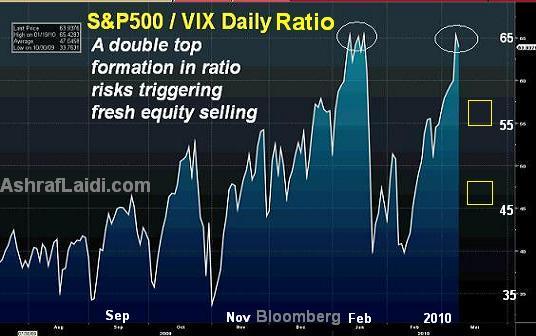
2. The chart below shows the 65.38 level in the SP500/VIX ratio coincides with the trend line resistance extending from the Aug 22, 2008 high through the January 19, 2010 high, 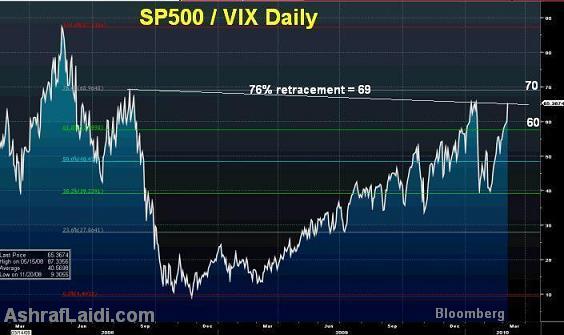
3. Finally, the weekly S&P/VIX chart below shows Fridays high of 65.38 also coinciding with the 200-week moving average; a high profile measure of long term trend. The last time the ratio neared its 200-week MA was in July 2007; 3 months before equities had hit their record highs.
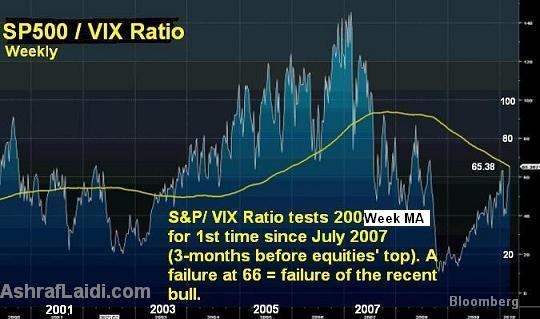
NOTE: The yellow text inside the chart should say 200-WEEK not 200-day MA
Such ratio analysis may not be the most popular approach to discerning market dynamics, but their viability can be just as relevant as price charts or macroeconomic technicals. We have shown on this site how ratio analysis of related markets could offer valuable forward-looking signals; Gold/Oil ratio ; Equities/ Gold ratio and gold/silver ratio
Failure of the SP500/VIX ratio to sustain recent gains would coincide with a clear technical failure and add more conviction to the technically-oriented equity watchers. We have seen S&P500 testing the trend line resistance from the mid Jan highs, while seeing the VIX deepening losses below 17, but it is the topping formation in the S&P 500 / VIX ratio, which could make the case for fresh downside in equities.
Meanwhile in currencies, we reiterate our initial call from March 2nd about the two vital points emerging in Forex confirming the US strength:
1. The daily correlation between USD Index and the SP500 is NO LONGER negative (+0.10) for the first time since August 2008. This is partly explained by the win-win scenario for the USD, whereby rising USD continues to emerge during falling stocks, but is also starting to emerge despite the recent increase in equities.
2. USD-denominated 3-month LIBOR is now equal to its yen counterpart at 0.25% for the first time in 7 months. It was in August 2009 when USD-libor fell below JPY libor for the first time ever, rendering USD the cheapest funding currency in the industrialized world and making it the preferred vehicle for carry trades into higher yielding FX, equities and commodities.
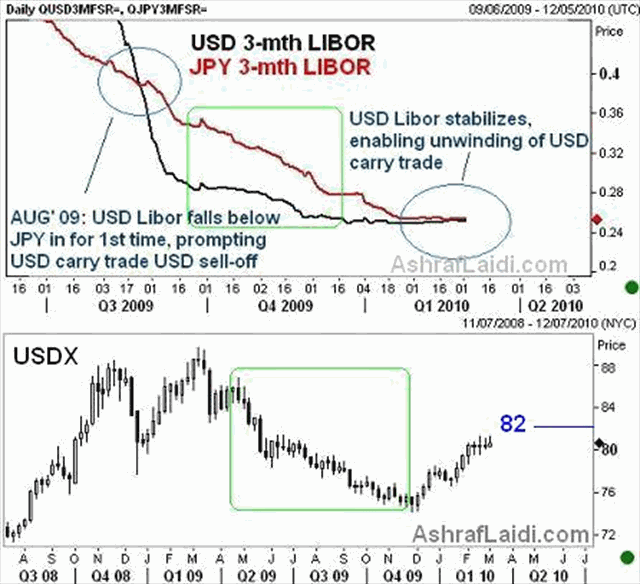
The stabilization process in USD LIBOR began in late November as the Dubai debt revelations caused the first blow to global risk appetite, causing a drying up in liquidity and stabilization in USD-liquidity. The reversal of USD-negativity was extended into early December when an unexpectedly strong US November jobs report (released on December 4th) boosted fed funds futures to expect a rate hike as early as June. The triple downgrade assault of Greeces credit rating (Fitch on Dec 8, S&P on Dec 17 and Moodys on Dec 22) magnified the move out of EUR longs as well as other risk assets to the benefit of fresh longs in USD.
Although USD Libor (0.25%) stands below its EUR counterpart (0.59%), it fared more positively over the last 3 months as it remained near 0.25% since November. That is in contrast to EUR Libor, which fell 15% from its November highs of 0.68%.
The stabilization in USD Libor costs reflects the fading of the USD-carry trade and the greenbacks improved performance regardless of equity performance. In fact, the correlation between USD index and the SP500 has now hit positive territory +0.10 for the first time since August 2008. This is partly explained by the win-win scenario for the USD, whereby rising USD continues to emerge during falling stocks, but is also starting to emerge despite the recent increase in equities.This supports our ongoing call for $1.32 in $EURUSD by end of Q1.




If the objective is to flatten the yield difference more then QE must be higher than 1 trn.
could you put a thread or subject on spread Two to ten and how it will affect the size of QE2 and its side effect on market correction.
thanks
i know u r busy in london
ustnotes at 126.50
then from there ... alice in wunderland
key to read the sandp
31/08 till 06/09
if one read a 335 then correction is due
if one read a 5 impulcive then expect some more upside but lilited to 1225. quite unlikely
http://bit.ly/cnxolZ
Ashraf
Ashraf
After a year or so of almost uninterrupted falling volatility, the last few weeks have seen a surge in the VIX (^VIX: 34.61 0.00 0.00%) and other measures of volatility. In fact the VIX more than tripled in a little over a month, jumping from an April 12 low of 15.23 to a May 21 high of 48.20.
One way to come to terms with the current 40ish level in the VIX is to think in terms of daily percentage changes in the underlying, the S&P 500 index (SPY: 107.818 0.00 0.00%). Technically, the VIX represents one standard deviation of the markets estimation of changes in the price of the SPX during the next 30 days. The VIX number is the size of that standard deviation in annual percentage terms, but since volatility is a function of the square root of time, in order to translate that annual standard deviation number into a daily number, one has to divide by the square root of the number of trading days in a year. A year typically has about 252 trading days and the square root of 252 is 15.87, which options traders generally round up to 16 in their head. Hence the Rule of 16.
Using 16 makes it easy to do some quick math in ones head. If the VIX is at 16, as it was a little over a month ago, one would expect that 68.2% of the time (one standard deviation), the daily change in the SPX would be 1% or less and 31.8% of the time it would be 1% or more. To simplify the math even more, options traders often make the mental conversion of 68.2% to two thirds. Since traders are generally more concerned about big moves than small ones, they tend to focus on the outlier portion of the standard deviation calculation, the one third of trading days which are more volatile than normal.
Using the rule of 16 and the 1/3 trading days time frame, the following translations should be committed to memory:
VIX of 16 - 1/3 of the time the SPX will have a daily change of at least 1%
VIX of 32 - 1/3 of the time the SPX will have a daily change of at least 2%
VIX of 48 - 1/3 of the time the SPX will have a daily change of at least 3%
Simple math allows us to do a linear interpolation. Today, with the VIX hovering around 40, options traders are expecting that the SPX will have daily change of 2.5% about 1/3 of the time.
Looking backward, as volatile as the market have been recently, only three days out of the past month have resulted in daily changes of 2.5% or more. In fact, for all of 2010, there have been only four days in which the SPX has been either up or down at least 2.5%.
In terms of conclusions, either market volatility is about to increase substantially from current levels or options traders have overestimated future volatility. As bearish as today has been, the SPX is only down 1.6% as I type this. If we have one or two more days in which stocks show average to slightly higher than usual volatility, expect the VIX to begin to move back down to a level that is a better reflection of those daily moves.