



Fed Cut May Come Before Oct 29
Risk appetite is slammed across the board on a combination of poor US economic data and negative corporate news. On the jobs front, US jobless claims surged to 490K, pushing the 4-week moving average to a new 5-year average. Durable orders tumbled 4.5% in August vs expectations of a 1.9% decline. In addition, GE suspends its buy back program and lowers its Q3 earnings. This follows the starkest economic from President Bush about a painful recession and a clear change in tone by Fed Chairman Bernanke.
Bernankes economic testimony sounded off a clear focus on the downside economic risks away from the usual balanced focus on inflationary and downside risks. This further increases the odds of an inter-meeting 50 bps rate cut. The next FOMC meeting is 34 days away, which is far too long a period of time for the rapid deterioration in credit conditions such as rising LIBOR/TED rates, as well as negative corporate news such as this mornings announcement from bellwether GE.
We have long held since May that the Federal Reserve would pause during the summer and continue easing in Q3-Q4. Never has the central bank raised rates before a marked decrease in the unemployment rate. And in the previous easing cycle, the Fed paused for 10 months during 2002 following the 2001 rate cuts, before adding 75-bps of easing from November 2002 to June 2003. In fact, were considering revising our forecast for a 1.50% low in the fed funds rate in 2008 to a low of 1.00% in 2009. Much attention has been given to the dislocation in credit markets and eroding confidence among credit institutions, but relatively little on the repercussions for the broader economy. With the unemployment rate having already breached the 6.00% before the end of summer and industrial production showing rare back-to-back monthly declines, much acceleration in economic dynamics remains ahead of us in light of the recent jump in layoffs and seizure in credit.
More economic evidence is due this morning. At 10 am EST, new home sales could drop by 2.0% to as low as 505K in August following 515K in July. Yesterdays release of the August existing home sales showed a 2.3% decline
EURUSD Dragged Down by EURCHF and EURJPY
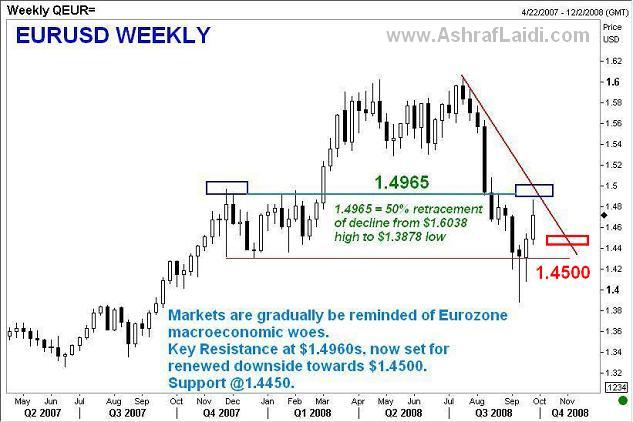
Despite the aforementioned US-centric news, Forex markets dragged down the euro by more than a full cent off its $1.4760 high on rumors of a failed European bank. Reduced risk appetite is damaging dragging euro against the low yielding franc and yen as these thrive on uncertainty. EURCHF drops from 1.5950s to 1.5906 while EURJPY drops to 155.20 from 155.75. Yesterdays disappointing IFO survey continues to weigh on the single currency. We expect EURUSD to gradually extend declines towards $1.46, followed by $1.4580. Key support stands at $1.45 for next week. Resistance has successfully held up at the $1.4960s, and will be imposed at the trend line resistance of $1.4730s.
Cables Upside capped at $1.86
Sterling is boosted by the dismal release of US news, but it is expected to be dragged anew by the lower yielding CHF, thus losing its high yielding against USD. Bank of Englands MPC member Andrew Sentance said today the UK economy could contract in H2 2008 but did not suggest a rate cut is the solution as his ultra dovish colleague Blanchflower consistently indicated throughout the year. We maintain that further Bo Erasing is inevitable despite the hawks holding to their anti-inflation views. Negative US data releases may not necessarily boost GBPUSD mainly due to the impact of falling risk appetite on the exchange rate. Thus, were more likely to see a decline in GBPUSD from positive US news than an increase in the rate from negative US news. We expect a retest of the $1.8450 today, before further declines reach to $1.8350 next week. .
Weakens on Asian Woes
USDJPYs ability to hold above the 105.80s in the midst of surging risk aversion is partly due to reports of a run on a bank in Hong Kong as well as the resurfacing tensions related to North Koreas nuclear program. Our bullish stance in USDJPY of the past 2 days is maintained through the week until wee see a third attempt to break above 106.30. Weak US data drags USDJPY below 105.80s, but support is seen emerging at 105.50. Expect more rumors of an intermeeting Fed cut, which could boost US stocks and USDJPY.
Bears Approach Kiwi Ahead of GDP Report
Less than 2 weeks after the Reserve Bank of New Zealand surprised with a 50-bp rate cut, Q2 GDP is due today, highlighting the reason for the central bank move. Q2 GDP is expected to drop by 0.4% q/q from -0.3% in Q1 and 0.6% y/y from 1.9%. Not only we expect further declines in NZDUSD, reaching 0.6780s from the current 0.6850 but we anticipate faster declines against CHF and AUD at 0.7330 and 0.8130 respectively.