


Time Zone: ET | GMT
ARTICLES INTRADAY
MARKET THOUGHTS
ANALYTICS FORUM BLOGS MEDIA ZONE BOOK USEFUL LINKS  


The QE Case for Gold & Silver

September 3, 2010 by Ashraf Laidi
(56 comments)
Print Share/Bookmark

The case for metals remains not that of outright inflation but that of central banks prolonged liquidity drives. Currencies will gain/fall versus one another, but fresh asset purchases will maintain gold and silver ahead.

Rising metals remained the consistent play over the past 2 months, supporting my near-term gold outlook for $1270/oz and $1,330 by Q4. Meanwhile, Silver finally breaks the $19.80 ceiling to attain its highest level since March 2008. Unlike gold, silver has yet break its 2008 record high of $21.35/oz. Players are gauging this level with high interest. Each time golds rise hits the headlines, it steels the limelight from it cheaper cousin; silver. But as the charts show below, silver has not only followed closely on the rallies, but usually outperformed gold during the general advances in metalsas shown via the falling Gold/Silver ratio below.
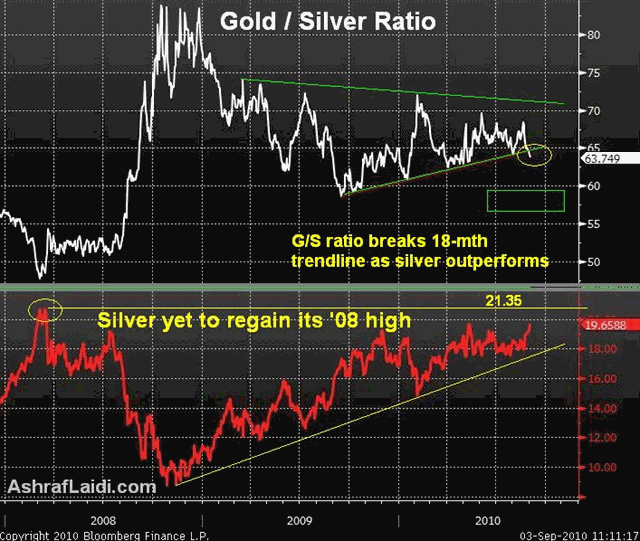
Aside from the evident dynamics of a possible QE2 (quantitative easing phase 2) from the Fed and the Bank of England, gold and silver are especially propped by upcoming wedding season in India (December-February). In general, the demand side is boosted by the Asian harvest, after which farmers spend their hard-earned income in gold. They also include cultural drivers,

The QE argument has also proven to empower gold and silver. We saw this in March 2009 when both the Bank of England and the Fed inaugurated their asset purchases programs. Not only those announcements helped cement a bottom in world equities (Mar 2009), but also helped reenergize the gains in metals and the rest of commodities. 18 months later, the US central bank is widely expected to resume shopping. Last week, Fed chairman Bernankes reiterated that purchases of long term assets are his favourite option for additional easing. The other options included communicating a longer period of exceptionally low rates and reducing interest rate on reserves. Note the Fed has already resorted to renewed asset purchases from the proceeds of maturing agency mortgages aimed at preventing the Balance sheet from contracting. The dollars next selling phase, is due when the Feds asset purchases program shifts from holding the balance sheet unchanged to expanding it.

Despite better-than expected August US jobs report, most private economists see the Fed adding fresh asset purchases later this year. The consensus is for the Fed to purchase between $300 and 500 billion in new US treasuries as part of its attempts to stimulate lending, enhance capital market liquidity and potentially boost the economy.

BoE/ECB/Lending Drive The QE argument for metals could further materialize once markets begin to price in QE2 by the Bank of England. This months comments from BoEs newest MPC member Martin Weale about the possibility for a double dip recession in the US have shaken out GBP, especially as his comments served as an offset for Andrew Sentance's usual rate hike demands. In fact, UK policy have taken a step back after the July core CPI slowed sharply to an annual 2.6%, the lowest since November. On the ECB side, JC Trichet told us this week the central bank will extend its 1-month and 3-month fixed rate lending facilities into Q1 2011. And with 3-month EURIBOR already falling to six-week lows at 0.884%, markets are thoroughly anticipating that central bank easing isnt going ending anytime soon.

Seasonals Helping too
My analysis of golds seasonals indicate that out of the last 8 years, Q4 proved to be the best quarter for the yellow metal, gaining in 7 out of the last 8 years. Q3 and Q1 followed behind, rising in 6 out of the last 8 years. With gold standing well above its 55, 100 and 200-day MAs for the first time since April, $1,275-80 remains the next key target before $1,330 emerges as the next high target. On the downside, $1,200 is starting to act as aninterim support, backed by the more resilient foundation of $1,160. As these dynamics emerge for gold, expect its cheaper cousin to perform at least just as much.

For more frequent FX & Commodity calls & analysis, follow me on Twitter Twitter.com/alaidi

 
    Comments By Users (56)   (View All Comments)    Post a comment

rim
Turkey

April 16, 2011 02:37 ET
Member since May 2009
Dear Ashraf ,

According to you what are the support and resistance levels of Gold / Silver ratio ?

Nowadays ratio around 36 , Can it reach once again 15 as in 1980 ?

Thanks
Frankfurt, Germany

October 29, 2010 05:34 ET
yes a very high risk US GDP today
no risk if it comes above expectation
then USDx will jump
if GDP comes below survey but I assume then USDx will drop and gold will raise
Jordan

October 29, 2010 05:02 ET
@catinp ,hi cantip do you think usdx will goes up ? bcz iam short gold.....do you see any risk .. thank u.
Frankfurt, Germany

October 29, 2010 04:55 ET
simple if USDx breaks 78 and sustained raising gold big selloff.
If USDx 80 XAUUSD below 1200
Jordan

October 29, 2010 04:49 ET
any thoughts on gold plz.
Frankfurt, Germany

October 28, 2010 15:23 ET
this is only possible if USDx reverses up , Could well be if tomorrow GDP data surprise to the upside
mulhouse, France

October 28, 2010 15:13 ET
Member since Aug 2009
get ready for gold at 1250/1272.5
New Mexico, US

October 28, 2010 09:49 ET
Member since Feb 2010
From Bloomberg:

HSBC Holdings Plc and JPMorgan Chase & Co. were accused in an investor's lawsuit of placing "spoof" trading orders to manipulate silver futures and options prices in violation of U.S. antitrust law.

The investor, Peter Laskaris, alleges that starting in March 2008, the banks colluded to suppress silver futures so that call options, or the right to buy, would decline, and put options for the right to sell would increase, according to the complaint filed yesterday in federal court in Manhattan. The collusion was also intended to maintain prices at levels at which some options would expire as worthless, Laskaris claims.

The banks placed so-called spoof trading orders, or the "submission of a large order which is not executed but influences prices and is then withdrawn before it reasonably can be executed," according to the complaint.

The Commodity Futures Trading Commission began probing allegations of price manipulation in the silver futures market in September 2008. At a hearing in Washington on Oct. 27, CFTC Commissioner Bart Chilton said there have been "fraudulent efforts to persuade and deviously control" silver prices and that violators should be prosecuted.

Joseph Evangelisti, a spokesman for New York-based JPMorgan, declined to comment. Juanita Gutierrez, a spokeswoman for London-based HSBC, also declined to comment.

Separate, Similar Complaint

A separate, similar complaint filed yesterday on behalf of investor Brian Beatty, and naming the same banks as defendants, claims a whistleblower contacted the CFTC last year and reported the banks' conspiracy to suppress prices of silver futures to profit from "enormous" short positions in silver futures.

The banks reduced their collusive trading and their holdings in the futures market after a government investigation of silver futures manipulation began in March, according to the complaint filed by Laskaris, which seeks class-action status. Since the banks cut back on their silver futures trading, prices have increased about 50 percent, the suit alleges.

"These price changes directly result, at least in one substantial part, from defendants' reduction in their concentration and other reductions of their unlawful activities in the silver markets since the government investigation," according to the Laskaris complaint.

Comex Trades

Laskaris described himself as a New York resident who traded in silver futures and claims damages based on the collusion. The trades at issue in the complaint were made on the Commodity Exchange Inc. division of the New York Mercantile Exchange, Laskaris said in the complaint. Beatty, a resident of Connecticut, makes the same claim.

Christopher Lovell, a lawyer representing Laskaris, didn't immediately return a call seeking comment after business hours yesterday.

Chilton spoke at an Oct. 27 hearing in Washington on regulations to implement the Dodd-Frank financial overhaul, which became law in July and gave the commission a year to establish rules governing the $615 trillion over-the-counter derivatives market.

mulhouse, France

October 26, 2010 05:10 ET
Member since Aug 2009
ROSE
IF 1334 broken frsh lows at 1325
rim
Turkey

October 26, 2010 01:50 ET
Member since May 2009
Dear Ashraf,

If FED wants to decrease unemployment and raise economy , instead of QE , can they decrease

taxes ? Maybe this is better for economy ,instead of printing money , f they ecrease the taxes

Thanks

    46 more comments...

You must be signed in to post comments.
 
   
Subscribe to Ashraf's Newsletter
Email:


Analytics

 
Hot-Chart - Dec 13
Where to for Gold & Silver?   Our Premium subscribers may not be surprised by the $100 decline in gold over . more..
 
Forex Charting
Forex Charts Powered by Forex Pros - The Forex Trading Portal.
 
 
Ashraf's Book:

Currency Trading and Intermarket Analysis
How to Profit from the Shifting Currents in Global Markets [read more..]
[buy now]
 
Tag Cloud (Top 20)

 
Interest Rates
US0.25%
 
JPN0.10%
 
EUR1.00%
 
GBP0.50%
 
CHF0.50%
 
AUD4.25%
 
CAD1.00%
 
NZD2.50%
 
NOK1.75%
 
 
Intraday Market Thoughts

2012.02.03: The strength of todays jobs report and services ISM attained the rare pattern of triggering a USD rally despite broad advances in US equities. The risk-on-risk-off rule of punishing the US currency during rallying equities does not apply when good

2012.02.03: UK PMI services strong; Eurozone retail sales declined; employment in Canada lower than expected and unemployment rate rose; estimates for 2/29 LTRO. Key event for NY is NFP followed by ISM non manufacturing. There are 5 already CAD shorts in the

2012.02.03: The yen and dollar are higher as risk trades are pared heading into US employment data and the weekend. The Australian dollar is lagging. Chinas services PMI fell in January in a tentative, but premature, sign of a cooling economy. Eurozone-wide and


Copyright 2008 © Ashraf Laidi.     Webmaster: | Privacy Policy
Loading...