


Time Zone: ET | GMT
ARTICLES INTRADAY
MARKET THOUGHTS
ANALYTICS FORUM BLOGS  NEW MEDIA ZONE BOOK USEFUL LINKS  


1999 & 2010 Similarities in USD, Euro

May 4, 2010 by Ashraf Laidi
(22 comments)
Print Share/Bookmark

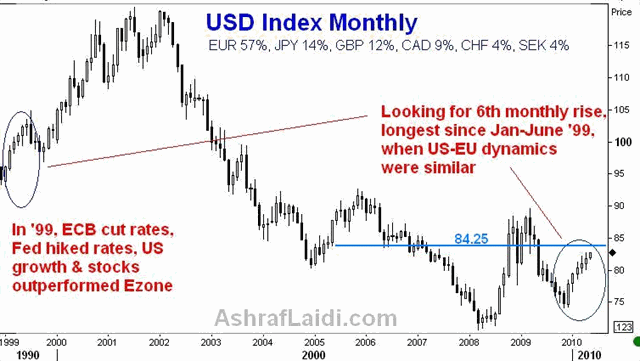
Starting the month on a high note, the US dollar index could be in for the 6th consecutive monthly gain, which was last seen in Jan-June 1999. Similar to today, 1999 was characterized by contrasting growth prospects between the US and Eurozone as well as escalating doubts with an overvalued euro, high ECB interest rates, and a Germany still reeling from the Asian crisis. (see chart below).

The other 2 striking similarities are the outperformance of US equities relative to their European counterparts as well as the anticipated Fed tightening to occur before that of the ECB. In 1999, the ECB was forced to cut rates in April, followed by a Fed rate hike 2 months later. Today, the Fed is signalling policy normalization (looking to sell assets, raise discount rate, concluded asset purchases), in contrast to the ECB, whose decision to suspend minimum credit rating requirements for Greek govt debt used in ECB liquidity operations comprises a de facto easing.
On the equity side, S&P500 and Dow-30 are +7.8% and +6.9% respectively, while the Dax-30, CAC-40, FTSE-100 and MSCI-Euro are all in the red at -5.2%, -1.11% and -4.8% respectively. These losses would be exacerbated by at least 4 percentage points if the USD returns were used instead of local currency returns.

USDX Focus Considering our expectations for $1.30 EURUSD before quarter-end (this has been our position since February and $1.27 ) before end of Q3, USDX carries momentum to make it past the 84 figue. That is especially given robust momentum in USDJPY, which is seen testing 97 along the same period. If the USD index sticks to its historical inability to rise for 7 straight months, it would mean that June could be a down month.

Super Thursday: ECB Decision/Press Conference & UK Elections

Neither the highest manufacturing UK PMI in 14 years, nor diminishing chances of a hung parliament to the favour of a Tory majority are sufficient to boost the pound against USD. Those planning to trade GBP around Thursdays elections are cautioned that Thursday will be driven by the much anticipated ECB press conference, where JC Trichet will have to explain the controversial decision to abolish minimum credit rating requirements for Greek govt. debt used in ECB operations. There is even talk of a surprise decision by the ECB to purchase bonds, in which case will magnify the contrasting policy directive between the US and ECB.

As the early exit polls will be released after 21:00 GMT Thursday, this means FX activity in GBP will escalate after NY Thursday close and into Friday Asian trade. The usual calm before the Friday Non-Farm Payrolls storm may not take place partly due to the volatility and recurring rumours on the election outcome. As it stands, chances of a hung parliament have fallen to 52% from the 62% reported 2 weeks ago by Betfair.com. Such an outcome is suggested by a Tory majority, which should be a definite positive for GBP. But the question remains: How early in the day will such an outcome be revealed? Thats what readers of this website and my followers on twitter will be getting on an continuous intra-day basis. http://twitter.com/alaidiGBPUSD bearishness must close below the $1.5120 support in order for any realistic chances to break into the $1.50 figure. Any election-driven upside surprise could see gains limited at $1.5380, but $1.55 remains a stubborn obstacle, drawing fresh offers back into $1.5070. In the event that neither major party succeeds in winning majority (hung parliament), fresh losses could drag GBPUSD towards $1.47 into the following week, especially if such an outcome proves to be a close call.

Click here for reminder of our warning on S&P500, Dow-30 and the signal from the Baltic Dry Index.


 
    Comments By Users (22)   (View All Comments)    Post a comment

nhtajnznfa, Andorra

June 16, 2010 03:44 ET
<a href="http://avhqmwcszxjddnx.com">wibcsermgnfcbnj</a> http://pmostrtqckpujth.com [url=http://xbdpjkgxzelimdc.com]kspjiiwbnbyberl[/url]
London, UK

May 16, 2010 20:00 ET
abdulrss, i dont see how these social media applications will see their end as many have found their usefulness.

ANOTHER major similarity with 1999 is the spectacular about face from the ECB, turning to a rate cut in from being so stubbornly hawkish.

The ECB's hane was forced by the economy in 1999 and today its forced by the sovereign debt crisis. And when centbanks make such a 180 turn, currencies do collapse.

Ashraf
May 14, 2010 06:58 ET
Hi Ashraf,
Very interesting to read your article on 1999 & 2010 similarities in USD Index. One query on it - 1999, we saw a huge rise in NASDAQ (tech stocks), and tech sector is performing quite well now. There is so much hype being built around social medis networking (likes of twitter etc). Do you think we might see a similar bubble build in tech stocks this time around too?

Cheers,
Abdulrss
China

May 6, 2010 10:45 ET
Member since Jan 2010
Thanks for your help, Ashraf

From learning history, I know at different period, market has different foucs. This is really a work which needs more experience to know which fact leads the whole market. I will keep on learning your book.
London, UK

May 6, 2010 08:05 ET
$USDX + $GOLD on a tear vs everything else. USD INDEX +3.3% so far this week, biggest weekly gain since 10/08

Ashraf
Korea Sout

May 6, 2010 05:30 ET
i have debt in your excellent analysis. the point is entry time. big picture is very accuracy. thanks ashraf for your help!!! ^!^;
London, UK

May 6, 2010 04:30 ET
Rob, 93.50 is not a bad point to buy USDJPY for 95 and 96 later in month. We can see 92.80 though if US jobs are disappointing, at which point is a better buy.

Ashraf
Rob
New York, US

May 5, 2010 14:14 ET
Member since Jan 2009
Hi Ashraf,

I'm long USD/JPY and wondering if you could give a solid support level for the pair. Not sure if I should add to my position at this point. Seems a winner in the long-run, but for now, risk-aversion seems to be crushing it. Any thoughts would be appreciated. Thanks.
London, UK

May 5, 2010 13:21 ET
Stationdelaer, yes Chine bubbleburst would hurt commodity currencies too. But the ensuing damage on global equities would also hit the very vulnerable euro.

Ashraf
Frankfurt, Germany

May 5, 2010 13:13 ET
I don't think call China bubble burst is anyway far fetched. About 60% of GDP is related to construction.
Sounds familiar ... if China goes bust UST goes bust, too ..and that is deflation not inflation.

    12 more comments...

 
Post a Comment/Response to this article
Enter you email/password:
Email:
Password:
Post without signing-in
Write your comment below
Attach Chart
 
   
Subscribe to Ashraf's Newsletter
Email:


Analytics

 
Hot-Chart - Sep 6
AUDCAD Where to from here?   AUDCAD has rallied 12% from its June lows as . more..
 
Forex Charting
Forex Charts Powered by Forex Pros - The Forex Trading Portal.
 
 
Ashraf's Book:

Currency Trading and Intermarket Analysis
How to Profit from the Shifting Currents in Global Markets [read more..]
[buy now]
 
Tag Cloud (Top 20)

 
Interest Rates
US0.25%
 
JPN0.10%
 
EUR1.00%
 
GBP0.50%
 
CHF0.50%
 
AUD4.50%
 
CAD0.75%
 
NZD3.00%
 
NOK2.00%
 
 
Intraday Market Thoughts

2010.09.07: Ashraf is featured in today's Financial Times' "View of the Day" (page 35) http://twitpic.com/ 2m3c60 disussing central bank easing, precious and base metals.


2010.09.07: YEN STILL DOING IT as the mere sign of profit-taking in global bourses, sends yen crosses falling across the board. AUDJPY proved once again unable to break the trendline resistance of 77.70s, extending from the June 21 high. And with AUDJPY Daily

2010.09.07: BACK TO SCHOOL & RISK AVERSION as Asian stocks dip back into the red; Jullia Gillard keeps power for Australias Labour Party thanks to the backing of 2 independents. Though her tax on resource makers is a watered down version of her predecessors


Copyright 2008 © Ashraf Laidi.     Webmaster: | Privacy Policy
Loading...