

Time Zone: ET | GMT
ARTICLES INTRADAY
MARKET THOUGHTS
ANALYTICS FORUM BLOGS  NEW MEDIA ZONE BOOK USEFUL LINKS  


US EU Bond Yield Spreads

by Ashraf Laidi
Print Share/Bookmark

Adding 10-year Spreads to the Mix

Rather than simply comparing currencies' overnight interest rates, FX traders pay close attention to differentials in 10-year yields for the market's assessment of longer term interest/inflation rate horizons. The relationship is straight forward. Currencies with a widening yield differential tend to appreciate versus their lower yield counterpart. The above chart shows EURUSD bottoming at $1.1715 in December 2005, nearly 2 months after the US-Eurozone 10-year spread peaked out at 0.55%. Fundamentally, the peak occurred when the ECB signaled the beginning of its tightening campaign, which ultimately took place in December. The US yield spread had accelerated around October 2004, once the Federal Reserve became increasingly expected to prolong its tightening campaign into 2005. But the U.S. yield advantage fizzled as the ECB began raising rates while the Fed's rate hikes were considered nearing their end. Identifying turnarounds in 10-year spreads enables a crucial advantage in currency markets.

Euro’s Breakdown in Line with Yield Spread Spike
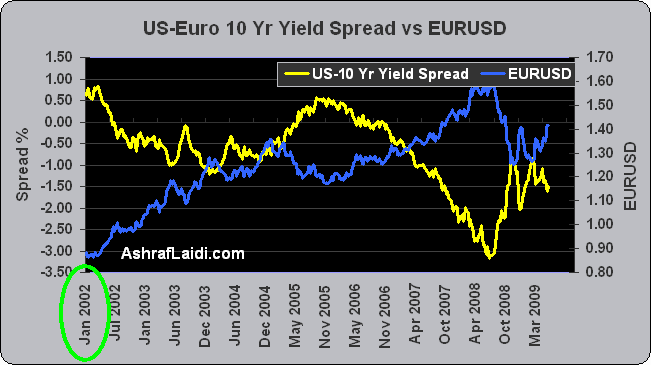
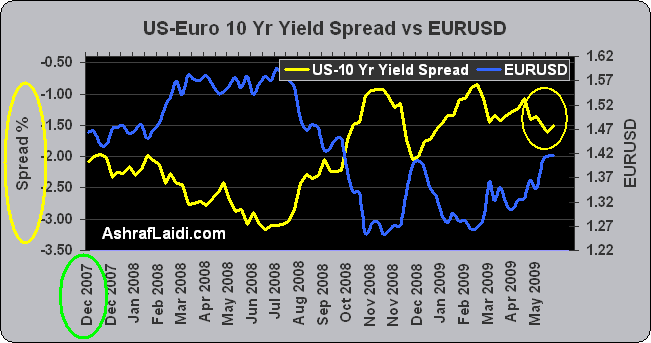
As EURUSD intensified its decline and broke below the major $1.47 support in mid August from its $1.6035 record high of mid July, the U.S. 10-year yield rapidly shrunk the deficit with its Eurozone counterpart from -3.20% to -2.32%. The $1.45 level in the euro is considered mainly psychological, but the $1.4360 point is a key technical foundation, representing the 38% retracement of the 1.1640-1.6035 move. This level corresponds near the -2.00% mark on the US-EU 10 yr yield spread, which is the high for the year.



 
    Comments By Users (44)   (View All Comments)    Post a comment

China

July 22, 2010 05:43 ET
Member since Jan 2010
Thanks, Ashraf

But the more I have learnt, the more difficult to judge whether to trade. I have been trading FX for 3 years, I don't know how long I could be a professional trader?
London, UK

July 20, 2010 10:28 ET
Saka, yes improving yield differentials in favour of German to help EURUSD for as long as the move is considerabl as is the case over the past 4 weeks and when it is supported by changing policy dynamics; in this case, eroding falling expectations of a tightening in US policy.

Ashraf
California, US

July 20, 2010 07:13 ET
Member since Jul 2010
Hi everyone . . .
Found some interesting stuff on YouTube: http://clicks.aweber.com/y/ct/?l=NDy8Z&m=I_GkiJXSxTWeOp&b=FjM5DtBrLOn1KWduGTZB0g
Tips on how-to install Expert Advisor.
China

July 19, 2010 09:22 ET
Member since Jan 2010
@Ashraf
Thanks for your tips. Just as what you describe, if eu's bond yield is higher than US', it is good for EU, am I right?

I am very sorry that I just have got a new job as a US stock editor last week and very busy, so that I didn't read your message. What a pity I miss a good opportunity to communicate with you....

@samof
hi, samof. My QQ is 776044530
London, UK

July 15, 2010 09:56 ET
saka, usually the currecny of the country;s whose yield is gaining does well. but it depends on the timing of the monetary policy outlooks.

Why dont you Tune in to my webinar this Sunday MIDNIGHT LONDON TIME which is decent timing for Japan.

http://bit.ly/bup7tZ

Ashraf
Chongqing, China

July 15, 2010 09:52 ET
Member since May 2010
Saka, are you Chinese? Would you give me your qq? Talking with Chinese better than English!
Beijing, China

July 15, 2010 04:12 ET
Dear, Ashraf

I have finished reading yoru book. But I only find the charpterw concerned with the spread of structrure of interest of a country. I want to know how to use the spreads of US EU bond to analys
EU, thanks!
Abingdon, UK

October 3, 2009 19:33 ET
Member since Oct 2009
Apologies if this is not the right place to ask, and also apologies if the answer turns out to be in the book (It's on order - not read it yet):

This is not directly related to bond yields but to the market price of bonds (my particular interest is in Eurobund and the related Bobl and Schatz). I can't get a handle on what it is that moves these from day to day and in the longer term. It has to be related to debt and interest rates in some way, and presumably also has a bearing on exchange rates as well, but how it all ties in, I don't quite see.

I presume that since government bonds (in stable countries) are one of the safest investments around, then the money goes there in times of risk aversion. So would I be right in thinking that the price of bonds tends to rise when Equities go down (and when the USD tends to go up, and EUR and GBP tend to go down)?

But I'm sure it's more complicated than that. Judging by the contents list of the book, I can't quite tell whether this question would be covered there. From my general reading around recently, I have picked up the impression that as well as everything else, an understanding of the bond market is quite important if we are to try to understand how the markets all fit together.

With thanks,
Regards,
M.
London, UK

September 4, 2009 08:25 ET
forextrader, makes sense but not sure about rising as far as 10%. if that happens, the selloff in the markets would have to be really ugly. but id probably say w/in 2-3 months.

Ashraf
london, UK

September 3, 2009 22:56 ET
Member since Aug 2009
Ashraf where can I view this chart updated?(source)

    34 more comments...

 
Post a Comment/Response to this article
Enter you email/password:
Email:
Password:
Post without signing-in
Write your comment below
Attach Chart
 
   
Subscribe to Ashraf's Newsletter
Email:


Hot-Chart - Jul 28
GBP Getting Best of Down Under   GBPAUD reflects contrasting expectations . more..
 
Latest Articles

 
Forex Charting
Forex Charts Powered by Forex Pros - The Forex Trading Portal.
 
 
Ashraf's Book:

Currency Trading and Intermarket Analysis
How to Profit from the Shifting Currents in Global Markets [read more..]
[buy now]
 
Intraday Market Thoughts

2010.09.03: RALLYING LOONIE accumulates gains post-US jobs, amid positive impact on Canadas economy from stabilizing US dynamics, and the rationale based on the fact that Canadas overnight rate remains below 1% and faces higher upside than any of the commodity

2010.09.03: MARKETS CHEER AUG US JOBS REPORT as payrolls fall by smaller than expected 54K and the unemp rate rises to 9.6%. More striking is the July figure was revised down to -54K from -131K, while the private payrolls rose by 67K vs exp 41K following 107K

2010.09.03: Ashraf's Video for Reuters Thomson illustrating the similarities of the interest rate cycles between the Fed and the Bank of England and QE2 by the Fed will lead to the same by the BoE http://bit.ly/ 9VAefQ


Copyright 2008 © Ashraf Laidi.     Webmaster: | Privacy Policy
Loading...